It is not possible to go to Costa Rica without the proper music! Actually at the Caribbean Coast that should be Bob Marley, but since everything goes, and there is a good blend (like, right now I listen to Indian music at Cafe Rico (where I have eaten the best Indian food outside India!), by the former named coast by the Caribbean Sea), I take a chance on Yeah Yeah Yeahs, because I just think that the girl is cool, and they will always remind me of CR.
Unfortunately Costa Rica is not the most cheap place, it is like living in Europe, and with bad salaries. I do not really understand how people get along here, and how they can buy stuff. The cost of living is expensive, even in the super marked food is priced like Europe. But for all I know it is probably a small group in the population that do all the shopping. It is the most developed country since Mexico, and it is also statistically the most dangerous one. There are more crimes being done here than the rest of Central America, or so I have been told. I will check it out. It is very influenced by USA, it seems to me that fruit companies and fastfood chains has taken over a lot (I see something that is USA everywhere). I hope that in the future tourists will not find a MacDonalds on top of a volcano or in another tourist friendly national park. I HOPE they will be able to live up to their slogan: Pura Vida, because they are doing so far (apart from all the US fastfood). But the pressure from tourists that really need their air conditioning on their 2-3 weeks visiting CR, in their summer homes or in hotels (to gawk at the bountiful nature and the animals), is big, and so pristine rivers are in danger of being dammed to produce the electricity needed. In the meantime, a Tica (Costa Rican) lives his hot, humid life without air con. I have visited a home here, they are hot, but made with high ceilings, and underneath the ceiling it is open space with just a net to provide air throughout. This is the mahogany tree houses, they are similar to what I saw in Belize, I do not know how the adobe houses are, but I imagine they are similar to those I have seen in Mexico.
My 3rd day in CR I decided to go to see the volcano Irazu. It is a big volcano with a main crater of 1 050 m. in diameter and 300 m. deep. It is the highest volcano in the country, 3 432 m., and it is possible to see both the Pacific - and the Atlantic Ocean from here on a clear day. I could not see anything for the rain and the fog. Irazu means "thunder" in the native language of the natives that used to live by it. A catastrophic eruption in 1723 destroyed a city, then capital of the country, Cartago, and an eruption in 1963 covered San Jose in a thick layer of ash. People used to think that Irazu blows every 30 years and was called "the deadly keg of powder".
In CR there are more than 112 volcanic formations. They belong to the Pacific Rim of Fire, and 7 are considered very active. The volcanoes are responsible for the very fertile soil that covers the territory of CR. They have all caused some major damage in the past. The most active volcano is Arenal, and Poas has the widest crater of diameter 1.5 km, the 2nd widest in the world. In 1950 it was decided that the land around the volcanoes should be protected, so many of them are within a national park. Irazu has its own national park. The CR volcanoes are stratovolcanoes, which means that the magma that fuels them is thick, viscous, and so filled with gasses that when they erupt the magma blast violently into the air. In the eruption of 1963 the clouds of smoke erupted, and ashes kept showering over San Jose and other parts for 2 years. People had to go out with a hankerchief and every day 13 cm. of ashes was swept down. 24th of August 2000 Arenal erupted, killed 1 person and injured 2. 600 people were evacuated from their homes.
To go to Irazu you can take a bus from where the National Theater is. It leaves 08:00 in the morning and you go back with the same bus 12:30 so you will want to buy a round trip for 4000 colones (US$ 8 (much more than you pay to travel in Nicaragua. The bus ride takes 2 hours. On top there is a small cafe that sells pretty good hot latte (you will need hot coffe because it is really cold up there. At the coffe shop they sell different suveneirs, among other things a note book made from banana paper. I think that this paper would be better to use to spare the rainforest. Under; a lonley, familiar dandelion has found its way to the top of a volcano in CR.
After one day of relaxing, swimming and reading books at the Rancho Merida, we went to Haris (a German man with horses for rent) place to ask about horseback riding. We agreed on coming back at 9 the next morning for a 3hour tour on the slopes of the Volcano Maderas, on the way to Haris place we saw a howler monkey, birds and a snake with suspicious colours slithered over the path. The colours are those of dangerous snakes, but there are imposters, so I am not sure if it is a dangerous snake or an imposter.
The day after we turned up before 9 in the morning and got horses, I had told them that I really, really want to run, to gallop with a horse is like flying the moment they lift all their legs, and I want to feel it again. I think I need to take riding lessons when I get some money! My horse is the grey one and called Marihuanito, our guides horse is Pinto and Rei-Hans horse is Pimento. I got Marihuanito because he likes to run a lot, however it was difficult to run since we were going up into the woods, balancing on rocky ground and slippery paths. So we went slowly up on the slope of Maderas to a point where we could get an overview (the picture below). From there w could see the isthmus with the lake on both sides and the Volcano Conception shrouded in clouds. Granda is on the right side of the volcano on the main land, but it was difficult to see all the way to Granada because of the hazy sky. We could see Costa Rica in the south (not in the picture).
On the way back down we took another way and ended up in el Comminidad Merida where the school is, and most people live. Down there on the road we let the horses run for a while, and went down to a beach named Cabalito where the horses enjoyed cooling down in the water. Sitting on the horse the guide warned ut that they like to lie down with saddle, rider and everything, so we had to be prepared to get wet. The guide was carrying my camera so I was not to worried, but Rei-Han had her camera so I can understand that she got worried. The horses waded deeper inn and started to splash water with their front legs, right before they were about to lie down, the guide took charge and got them all up. We got out of it just slightly wet, but I was a little disappointed that I did not experience the lying down.
I really, really enjoyed this trip through beautiful fields and forest, with strong healthy horses (I recommend Haris horses if you go to Isla de Ometepe). When we were at Rancho Merida, there was a group of volunteers at Hacienda Merida, next door. They had just finished their studies, so they were new veterinarians
who want more experience and also want to help the community with their services. The program started by Hacienda Merida has been going successfully for 5 years, almost all of the students and new beginners from Oregon. So every day there was a zoo of animals lined up to get a veterinarian check up, dogs, cats, horses, donkeys, pigs, mules, cows and goats. All the animals that had been checked had this cute scarf around their neck, so there were all these dogs running around with a scarf. There were quite many fresh vets there, some with their spouses, and it was really interesting talking to them about the project and the work. They do it for free, so the people just have to show up with their animals and wait. Every morning before the gate opened there would be a line of people and their animals. Haris people took 5 horses and 11 dogs. One of the dogs is an Inka dog (picture above).As you can see it is naked! And it is a very rare rase, it feels strange to pet it, and it is not very beautiful, but it is friendly and cute. They also have 2 huge dogs, one boxer or something called Martha, and another weird looking giant called Agatha, then there were 4 tiny, skinny ones that I was afraid to step on, and some of uncertain origin. There were 4 cats, one called Emma with only 3 legs, 2 in the front and 1 in the back. One of her legs was grabbed by an armadillo when she was a kitten, and it had to be amputated. She did not seem to suffer from it at all, and did not care about if any of the dogs were around. She willingly came to my lap. After riding I spend a lot of time in the lake. A young man from Costa Rica was in Rancho Merida, and we stayed in the lake until long after dark, talking about life. He is a dentist and has a lot of interesting knowledge that I recognize in myself (that is interesting to me (since I have an "alternative" view of the world). I find that a lot of people understand where I come from and how I think over here, so maybe I was miss placed somehow in this world? There are people with a different consciousness (that HAS awareness) out there, and I am so blessed to meet them so that they can teach me more about my own knowledge).
Look at the volcano! It never looks the same, ever, so you can never grow tired of looking at it!
After my stay in Posto Rojo I went directly to Isla de Ometepe. I jumped on a bus at a road conjunction where busses came from Managua heading south to Rivas. It was an good old Bluebird (the chickenbus), and it cost less than $2 to get to Rivas. From there I had to get a taxi to the ferry dock, and crossed over to Moyogalpa in 1 hour. It is a beautiful crossing with the view toward the island where 2 volcanos are looming. The twin volcanos are enough to capture anyones imagination, rising up from the massive (8 264 km2, a little smaler than Titicaca in Peru /Bolivia and the 9th largest in America) lake in Nicaragua. The original name of Lake Nicaragua is Cocibolca - sweet wather. Among the admireres of the island is Mark Twain, who described it lyrically in his book Travels with Mr. Brown. The fertile volcanic soil, wide beaches, the wildlife population, archaelogical sites and dramatic profile have landet the island on a shortlist for new Seven Natural Wonders of the World. It is certainly one of the most amazing things I have ever seen; two volcanos rising up from a huge lake, it is not only spectacular from the ferry, it is equally spectacular on the island itself. I departed from San Jorge with this little car ferry. I am not an expert of logistics, but it I do not have to be a genius to see that the way they first put the big truck in the middle and then there where 3 small vans more to get inside. The ferry left the dock heavier on one side, but they can get away with it here, the one hour ferry ride was on a calm lake, but the lake is only 26 meters at its deepest, so I if the winds are really strong the waves can be quite high. In fact I have heard that people do get seasick on the 4 hour ferry ride from Granada, and I thought about the ferry ride on Pirihueico many years ago when I traveled in South-America with huge waves crashing OVER the ferry. I remember sitting on the sundeck on top of the ferry, feeling seasick and getting splashed by wather, so I had to go downstairs where the waves did not feel that high. In Patagonia the winds are so strong, all the time, that it wips up the lake in a fury 24 hours. The lake is in the 7 lake district in Patagonia. To go to Ometepe you can either take a ferry; Ferry 1, Ferry 2 or Che Guevara for 60 cordoba or take one of the "pangas" (40 cordobas) on the picture below (I think they are very slow and overfilled). They arrive on the island either in Moyogalpa or in San Jose del Sur. I had no idea where I would arrive, because I forgot to check it before I left, but I was quite sure that I would land in Moyogalpa, and I did. In Moyogalpa I found the Hostal Central or Indio Viejo as it is also called, owned by an old man who claims he is born in a tribe of this island. I do not believe him; he is fluent in French and English, but not in Spanish, and his children and staff all speak French, bad Spanish and NO English. They listen to French music and only speak French among them. The lake drains to the Caribbean Sea by the river San Juan, makeing Granada an important Atlantic port. It was suggested that a canal would be made at the narrow isthmus at Rivas, but in stead the Panama Canal was buildt. In fact the lake presses the land into such a narrow belt that it barely separates the lake from the Pacific Ocean and geological evidence suggest that there was no separation between the lake and the ocean in distant past. The isthmus of Rivas is replete with history. Although known as the land of Nicarao, the area was first inhabited by the Kiribisis tribe, whom the more powerful Chorotegas pushed aside. The Nicaraos came afterward, and by the time the Spanish “discovered” the region, it had been residents here for at least seven generations.
Main land.
It’s hard to compete with La Isla de Ometepe for attention. The magnificent twin-peaked Ometepe rises like a crown from the center of Lake Cocibolca. An intensely volcanic island steeped in tradition and mystery, Ometepe was the ancestral home of the Nahuatl people and today is an alluring destination for travelers, with its sandy beaches, swimming holes, hiking trails, and of course, two breathtaking volcanoes: one hot, one cold (the former remains quite active).
The Cosigüina Volcano was once upon a time the tallest volcano in whole Central-America, from the size of it`s base, perhaps more than 3 000 m. It all changed one beautiful day, in January 1835, when the most violent eruption in the Americas, since colonization, blew most of this hot-blodded volcano away in one single blast. The eruption paved the oceans with pumice, left 3 countries in the dark for 3 days, and scattered ash from Mexico to Colombia. Today a beautiful lake fills the remains of the mighty volcano, and you can reach it on a 3 h. blistering, or more like scolding, hot trekk from el Communidad Potosi. To arrange the tour you can either go through Pure Planet travel agency, take the very bumpy 3-4 hour chickenbus ride from Chinandega to Potosi or do like I did; I went to Jiquilillo where I met William and Fabienne and I talked to them about it. They also wanted to see the lake in the crater of the volcano, so we had Nate contacting Tina to ask if she had some guests that also wanted to go. They had one guest that wanted to go, so we hired a guide, Eddie, (you have to have a guide, people have died up there) and a ride and left Nates ranch 5 am in the morning. Many roads in Nicaragua are not paved, so after 30 min. driving there was only a dirtroad, and because of the rain, it had all those small lakes. I was afraid that it would be to muddy or to deep for our van to pass through all theese "roadlakes", I would not want to get out of the car to step into "puddle" with kneedeep wather. It seemed to me that we needed a car-boat of the kind the military use, or Austin Powers (if he has a car that can turns into a boat). But the locals here know what they are getting into, so they would not buy a fancy car that can not handle the obstacles of this country, so our little Toyota van, old and ratteled as she is, got us over to dry land again and again, and after crossing many "lakes" we climed a bit higher, and there were no more giant puddles! When we came up to el Communidad Potosi, also a natural reserve, a big delta and wetland area, teeming with birdlife.
The climb up the volcano was very hard for me, it was hot and a lot of wild wilderness to get through, I came up 2-3 min later than the others. Actually I almost wanted to give up when I was almost up because from below it does not look like anything special, but when I came up and looked over the edge of the crater I saw the most beautiful lake, with the clouds mirroring themselves in it. I was really happy that I had struggeled my ass all the way up, it was not the hardest climb I have done since it is not a very steep trail, but it was hard because of all the wilderness and the heat. I was glad I did not give up on the way up. My legs were sore and scratched from thorns, spines and malicious insects that bite and sting. The climb down was actually not easier, it was harder because of the power of concentration I had to put into it to not fall down and break a leg or an arm.
From the top of the volcano, you can see Honduras and El Salvador on a clear day.
After the climb up we went to swim in this hot spring in the Potosi Community, the wather was not hot though, it was lovley refreshing. Underneath; a house from Potosi.
The local toilets. The pic under are from el Communidad Cosigüina, we stoped there for food, a local woman had made us each a traditional plate of chicken, rice, refried beans and eggs.
This is how it looked outside the car when we drove to and from Potosi.
William, Fabienne and I also went kayaking in Padre Ramos, it was a lot of fun. We went into the mangroove forest with a guide called David, who is a local of Jiquilillo. If you go without a guide you might get lost among the roots of the trees. During the kayaking it started to rain and a heavy thunderstorm was upon us, so we did a lot of kayaking in the pouring rain.
Beutiful Leon! The first real city that I have been in in a while. Drop dead gorgeous in the worn out, crumbling-down kind of way with its fabulous art collections, beautiful churches, cosmopolitan eateries and great nightlife. Originally Leon was located on the slopes of Volcano Momotombo, and from what I understand the Spanish conquistadores committed some of their cruelest excesses in old Leon, so when the mighty volcano reduced the original Leon to rubble and sand in 1610, even conquistadores, in other places, saw it as divine punishment. The city was doomed from the start, settled by unusually cruel and money-hungry tyrants, whose public spectacles included beheadings and setting wild dogs on capturing natives in the central plaza. After a number of earthquakes between 1580 and 1608 and finally the outbreak of Momotombo in 1610 the Spanish fled, carried with them what they could, to build up the city again where it is today, stone by stone and saint by saint next to the indigenous capital Subtavia. The old city was forgotten and buried for 300 years, and today it is a tourist attraction and a UNESCO World Heritage Site. I did not go there to see it, there is not much to see. A dictator, Anastasio Somoza Garcia was assassinated in Leon by the poet Rigoberto Lopez in 1956, something the ruling family never forgot. When the revolution came the family got its revenge on Leon for the murder with a hail of bullets and bombs that are still scaring the city. A good place to stay in Leon is the Bigfoot Hostel that has the Pure Earth Cafe http://www.bigfootnicaragua.com/pureearth.html with wonderful vegetarian food, all the food is vegetarian with the use of organically grown veggies and they have pizza nights on Wednesday and Sundays. The bagels are super tasty and you can get an excellent huge cup of cappucchino and fruit juices. Bigfoot is connected to Green Pathways a travel agency that promotes sustainable tourism. http://www.sustainabletrip.org/profile/greenpathways. Bigfoots biggest attraction among travelers is the volcano boarding http://www.youtube.com/watch?v=UP3_UMAvyHQ and many people come to Leon just to slide down the slope of Cerro Negro. As far as I know it is the oonly volcano in the world it is possible to slide down. It is a lot of work getting up, carrying a heavy board of wood, and then with an orange suit and goggles you slide down. It takes a few seconds, when you are back in the hostel you are rewarded with 2 homemade mojitos (they are excellent by the way) and if you break the record you get 5. At the moment an Israeli girl has the record; 87 km. pr. h. and a boy from England has the mens record 88 km. pr. hour down the slope. Look for offers at the Hostels. The second day in Leon I went to the museum for legends and history together with Amanda and Camilo, it was the most scary and disturbing thing I have seen. It was full scary, badly made figures. In one room they have some history of torture that went on, on children and women even, during the revolution. And the other rooms are just full of big dolls or figures. Unfortunately I did not bring my camera but check out this website http://www.chickybus.com/2011/04/trippy-travel-photos-5-10/ and you will get the idea. The museum was a prison before it became this weird museum.
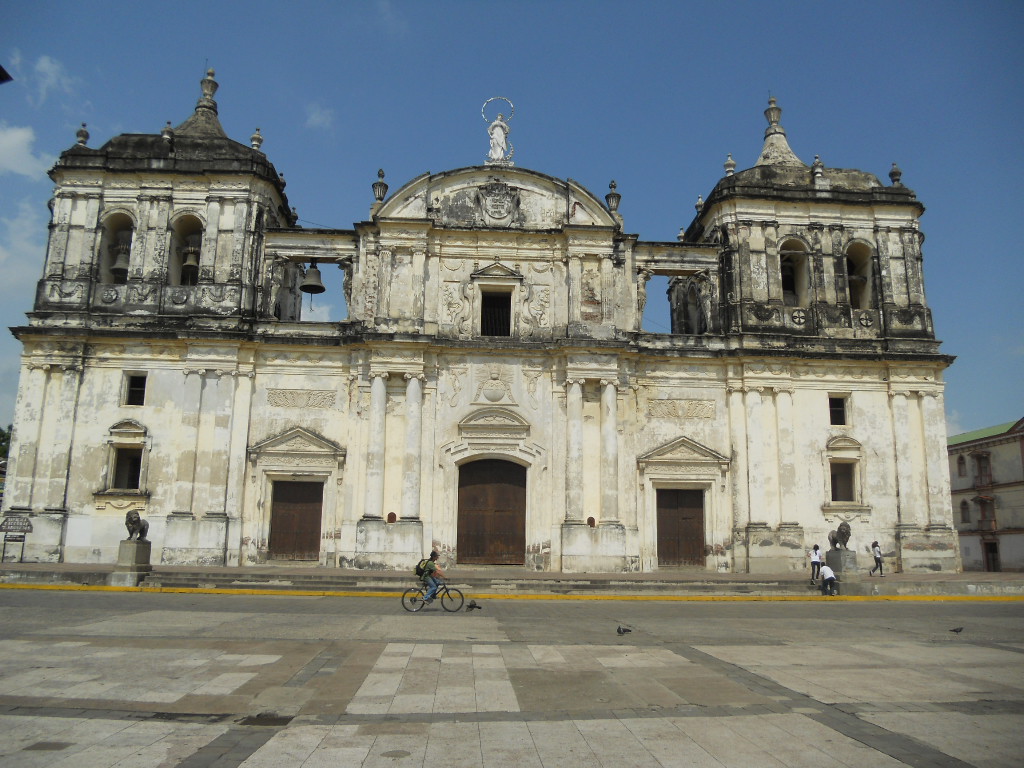
This is the biggest cathedral in Central-America and accroding to a story I heard it was supposed to be buildt in Lima, Peru and not in Leon, Nicaragua. It was approved for Lima because Lima was a much more important city for Spain, and in Leon, a much more modest onchurch was approved. The architect Diego Jose de Porres Esquivel, the Capitan General of Guatemala (he is also responsible for other beautiful and famous churches in the Americas) pulled a "switcheroo" and buildt this cathedral in Leon, and Lima got the modest one. The name of it is the Basilica de la Asuncionand, and it is the pantheon of Nica (Nicaraguan) culture. The tomb of Nicaraguas beloved son, the poet Ruben Dario is on one side of the altar, guarded by a sorrowful lion.
Streets in Nicaragua.
One very old church in Leon.
Nica heroes.
Inside the cathedral.
A beautiful church near the Parque central in Leon.