First I want to present the most popular song in Nicaragua for the timebeeing. This raeggeton rythm is good to get in a good mood and in a dancemood..
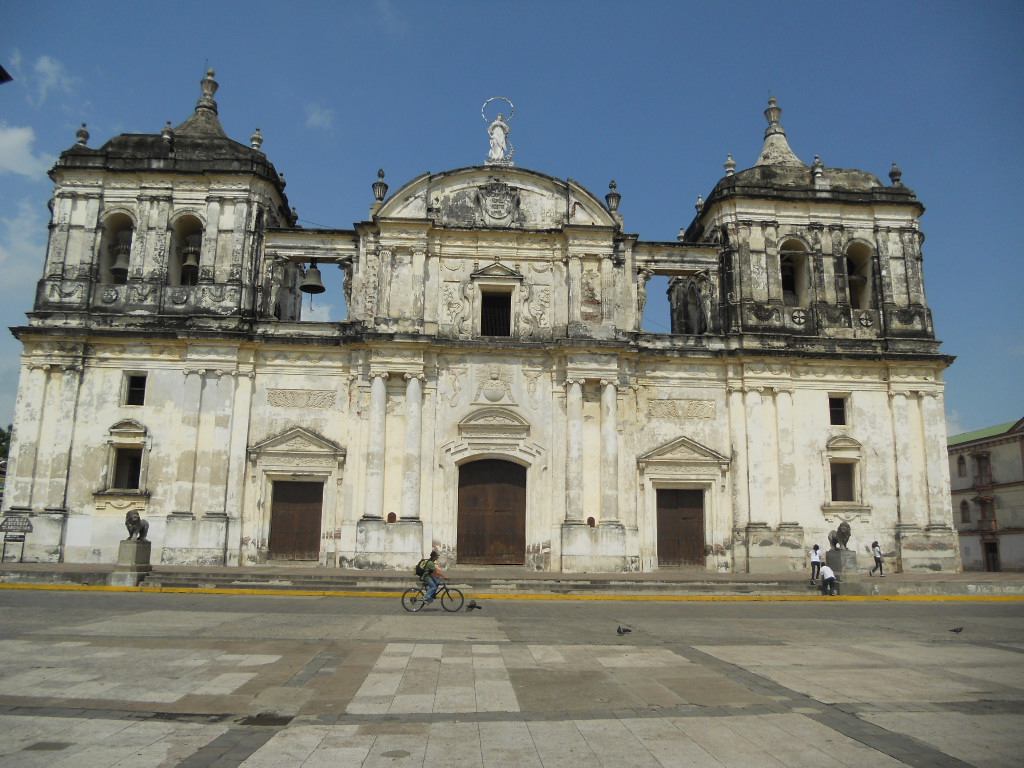
Granda is considered one of the most beautiful cities in this part of the world, with its churches and colonial buildings. Yes, it is quite beautiful, but I guess I appreciate so much the more remote areas, and the rustic quality of Nicaragua rather than the cities. I have discovered that here there is more nature to indulge in. And after seeing a sunset in Jiquilillo that could be written hundreds of poems about, I find city's too full of buildings. Before I left Jiquilillo together with William and Fabienne we went kayaking which was great fun. We were out 3 hours in the afternoon, and when we came back after kayaking most of the time in a thunderstorm, the skies had cleared up and we could enjoy an awesome sunset. In the West the sky was an explosion of pink, orange, yellow and red, the colours mixing with the ocean that was throwing itself forcefully towards the beach. The colours from the sky mirrored themselves in the ocean and blended with the ragging grey foam from the ocean. In the East the sky was grey and blue, grey leftover from the thunderstorm. The beach was the colour of liquid gold, as was the wather that crashed in. It was the most beautiful sunset that I have seen by the ocean. Only a thunderstorm can create such fierce colouring of the sky and ocean. Anyway, after getting back to Leon, I slept there one night and took the bus to Granada. To get to Granada I had to pass through Managua, so I took the buss marked UCA, from there you can get connections to Granda without having to take a taxi across the city to another bus stop. UCA connects Managua to many cities and towns. I was surprised when we came into Managua. Since I have heard bad things about the city I expected to see grey, ugly fabrics and a dreary place. But coming into the capital city I saw only trees. It was like the nature has taken over the city and the only somewhat dreary thing I saw was the mud hole where the buses stop. On the way south I saw some more of the city, but not quite the center of it. I could not figure out where the center of the city might be since I saw only trees, and all the properties I saw looked like they had big gardens. Usually the trip with minivans are more comfortable than with the chickenbus. But the minivan from Managua continued to pick up people until the door could not be closed. many had to stand in an umcomfortable position.

The minibuses are the fastest way to get to Granada from Managua. You pay 20 cordobas to go, that is less than $ 1. Granda is historically the most important city of Nicaragua, it was founded in 1524 by Francisco Hernández de Córdoba and one of the first European cities in mainland Americas. Unlike other cities who claim the same, the city of Granada was not only the settlement of the conquest, but also a city registered in official records of the Crown of Aragon and the Kingdom of Castile in Spain. Granada is also known as La Gran Sultana, by its Moorish and Andalusian appearance, unlike its sister city of León and historical rival, which has Castilian trends, both of the Baroque time. It was named by Hernández de Córdoba after the ancient Spanish city of Granada. This was done in honor of the defeat of the last Moorish stronghold, which had been Spanish Granada, by the Catholic King and Queen of Spain. Granada, Nicaragua was historically the sister capital in Central America to Antigua, Guatemala. During the colonial period, Granada maintained a flourishing level of commerce with ports on the Atlantic Ocean, through Lake Nicaragua (original name Cocibolca) and the San Juan River. The city has been witness and victim to many of the battles with and invasions from English, French and Dutch pirates trying to take control of Nicaragua. It was also where William Walker, the American filibuster, took up residence and attempted to take control of Central America as a ruling monarch. One of Walker's generals, Charles Frederick Henningsen, set the city ablaze before escaping, destroying much of the ancient city and leaving printed the words "Here was Granada". For many years Granada disputed with León its hegemony as the major city of Nicaragua. The city of Granada was favored by the Conservatives, while Léon was favored by the Liberals. For many years there was conflict that at times became quite violent between the cities' families and political factions. In the mid-19th century a compromise site was agreed on and the capital was finally established at Managua between both cities .
For the most part Granada avoided damage during the years of conflict in Nicaragua in the 1980s.

Maybe it has something to do with the of the year, but it seems to me that Nica towns and cities are not the most noicy kind. Gates where locked, and in the street I had to watch out for horses and bikes, not so many cars. I found my favourite cafe in the center, Cafe Euro with really good coffe, vegetarian food and great WiiFii to do some writing and research online. Hostels I can recomend are the Liberdad (it has organic pizza night every night, and the pizza is super delicious) and the Bearded Monkey across the street. Don`t let the bedbugs bite :)

Pic from the central park in Granada.