Bocas del Toro is also the name of the province. Its extension is 4,643.9 square kilometers comprising the mainland and nine main islands. The province consists of the Archipelago of Bocas, Bahía Almirante (Almirante Bay), Laguna de Chiriquí, and adjacent mainland. The capital is the city of Bocas del Toro (Bocas Town to most people) on Isla Colón. Other major cities or towns include Almirante (from where you take the boat (and the bus to other places in Panama or to Changinola for transefere to Costa Rica) and Changinola. The province has a total population of 125,461 people (2010). The area was discovered by Christopher Colombus in 1502. Bocas del Toro borders the Caribbean Sea to the north where the Smithsonian Tropical Research Institute operates a research station northwest of Bocas Town. The archipelago attracts more travelers every year, but its ecosystem remains largely intact due to the admirable efforts of conservationists. In fact, the biodiversity of the Bocas del Toro region is so exquisite, it’s internationally recognized as both a Biosphere Reserve and a UNESCO World Heritage Site.There are many banana plantations in Bocas del Toro, often called the oro verde or green gold of Central-America. Under, a beautiful mahogany house I would like to live in.
Where am I
Mostrando entradas con la etiqueta UNESCO World Heritage Site. Mostrar todas las entradas
lunes, 31 de octubre de 2011
Bocas del Toro
All the boats from the mainland have their docks in Bocas del Toro (the town), so if you are going to stay on another island you have to take another boat. Bocas del Toro is known as the 'party town', there are bars everywhere. Most people living there are Afro and Afro-Caribbean, then a Chinese population, Lebanese and indigenous people. Now there is a big immigration of people from USA and Europe to the islands. You see them everywhere, there are many, and many more will come. If you are European, from USA or Chinese owning a super marked,you are likely to be living in one of the big beautiful houses on the pictures below. If you are indigenous or of African or African-Caribbean origin you will be more likely to live in a small box of a house like this house below. It is incredible how many people they fit into a small house like this. The house on the picture looks nice, most of the poor people live in smaller more run down houses. You see them a little bit away from the fancy hostels and hotels that are owned by foreigners (Swiss, Germans). The hospital in the town however is not very fancy or well equipped.
Bocas del Toro is also the name of the province. Its extension is 4,643.9 square kilometers comprising the mainland and nine main islands. The province consists of the Archipelago of Bocas, Bahía Almirante (Almirante Bay), Laguna de Chiriquí, and adjacent mainland. The capital is the city of Bocas del Toro (Bocas Town to most people) on Isla Colón. Other major cities or towns include Almirante (from where you take the boat (and the bus to other places in Panama or to Changinola for transefere to Costa Rica) and Changinola. The province has a total population of 125,461 people (2010). The area was discovered by Christopher Colombus in 1502. Bocas del Toro borders the Caribbean Sea to the north where the Smithsonian Tropical Research Institute operates a research station northwest of Bocas Town. The archipelago attracts more travelers every year, but its ecosystem remains largely intact due to the admirable efforts of conservationists. In fact, the biodiversity of the Bocas del Toro region is so exquisite, it’s internationally recognized as both a Biosphere Reserve and a UNESCO World Heritage Site.There are many banana plantations in Bocas del Toro, often called the oro verde or green gold of Central-America. Under, a beautiful mahogany house I would like to live in.
How much time do you have to travel? It can take months to explore all of Bocas del Toro’s 9 major islands, 50 cays (low, coral-based islands), and 200-plus islets.Most people do not do that. like I said, the nightlife is great in Bocas Town and on Aqua Lounge, 30 seconds by boat to Isla Caremero. The second night in Bocas I went to Aqua Lounge with people from Heike. It was "ladies night Wednesday", free drinks for women until 24:00. One of the best parties I have attended in ages, people were dancing, the music was good and some people got so drunk that they jumped from the dance floor into the water. Beach-lovers and sufers (you’re in for a treat!) will be eager to begin their island-hopping. However, Bocas Town itself has lots to offer in dining, nightlife, and accommodations. It’s an archetypal Caribbean village of pastel rooftops, fresh seafood served in waterfront restaurants on stilts, fishing boats in bold, primary colors, and docks stretching over the patchwork waters. Playa Bluff is the town’s most dazzling beach. I went there by bike on my forth day in Bocas. Some advice if you are going on dolphin sightsing; make sure you go with a tour company that does not hurt or disturb the dolphins. If they act reckless towards the animals, let them and everybody know so that they will not operate again.
Bocas del Toro is also the name of the province. Its extension is 4,643.9 square kilometers comprising the mainland and nine main islands. The province consists of the Archipelago of Bocas, Bahía Almirante (Almirante Bay), Laguna de Chiriquí, and adjacent mainland. The capital is the city of Bocas del Toro (Bocas Town to most people) on Isla Colón. Other major cities or towns include Almirante (from where you take the boat (and the bus to other places in Panama or to Changinola for transefere to Costa Rica) and Changinola. The province has a total population of 125,461 people (2010). The area was discovered by Christopher Colombus in 1502. Bocas del Toro borders the Caribbean Sea to the north where the Smithsonian Tropical Research Institute operates a research station northwest of Bocas Town. The archipelago attracts more travelers every year, but its ecosystem remains largely intact due to the admirable efforts of conservationists. In fact, the biodiversity of the Bocas del Toro region is so exquisite, it’s internationally recognized as both a Biosphere Reserve and a UNESCO World Heritage Site.There are many banana plantations in Bocas del Toro, often called the oro verde or green gold of Central-America. Under, a beautiful mahogany house I would like to live in.
Etiquetas:
Archipelago,
banana plantation,
beach,
Biosphere Reserve,
Bocas del Toro,
ecosystem,
party,
UNESCO World Heritage Site
Ubicación:
Caremero, Bocas del Toro, Panama
domingo, 4 de septiembre de 2011
Leon
Beutiful Leon! The first real city that I have been in in a while. Drop dead gorgeous in the worn out, crumbling-down kind of way with its fabulous art collections, beautiful churches, cosmopolitan eateries and great nightlife. Originally Leon was located on the slopes of Volcano Momotombo, and from what I understand the Spanish conquistadores committed some of their cruelest excesses in old Leon, so when the mighty volcano reduced the original Leon to rubble and sand in 1610, even conquistadores, in other places, saw it as divine punishment. The city was doomed from the start, settled by unusually cruel and money-hungry tyrants, whose public spectacles included beheadings and setting wild dogs on capturing natives in the central plaza. After a number of earthquakes between 1580 and 1608 and finally the outbreak of Momotombo in 1610 the Spanish fled, carried with them what they could, to build up the city again where it is today, stone by stone and saint by saint next to the indigenous capital Subtavia. The old city was forgotten and buried for 300 years, and today it is a tourist attraction and a UNESCO World Heritage Site. I did not go there to see it, there is not much to see. A dictator, Anastasio Somoza Garcia was assassinated in Leon by the poet Rigoberto Lopez in 1956, something the ruling family never forgot. When the revolution came the family got its revenge on Leon for the murder with a hail of bullets and bombs that are still scaring the city. A good place to stay in Leon is the Bigfoot Hostel that has the Pure Earth Cafe http://www.bigfootnicaragua.com/pureearth.html with wonderful vegetarian food, all the food is vegetarian with the use of organically grown veggies and they have pizza nights on Wednesday and Sundays. The bagels are super tasty and you can get an excellent huge cup of cappucchino and fruit juices. Bigfoot is connected to Green Pathways a travel agency that promotes sustainable tourism.
http://www.sustainabletrip.org/profile/greenpathways. Bigfoots biggest attraction among travelers is the volcano boarding http://www.youtube.com/watch?v=UP3_UMAvyHQ and many people come to Leon just to slide down the slope of Cerro Negro. As far as I know it is the oonly volcano in the world it is possible to slide down. It is a lot of work getting up, carrying a heavy board of wood, and then with an orange suit and goggles you slide down. It takes a few seconds, when you are back in the hostel you are rewarded with 2 homemade mojitos (they are excellent by the way) and if you break the record you get 5. At the moment an Israeli girl has the record; 87 km. pr. h. and a boy from England has the mens record 88 km. pr. hour down the slope. Look for offers at the Hostels. The second day in Leon I went to the museum for legends and history together with Amanda and Camilo, it was the most scary and disturbing thing I have seen. It was full scary, badly made figures. In one room they have some history of torture that went on, on children and women even, during the revolution. And the other rooms are just full of big dolls or figures. Unfortunately I did not bring my camera but check out this website http://www.chickybus.com/2011/04/trippy-travel-photos-5-10/ and you will get the idea. The museum was a prison before it became this weird museum.
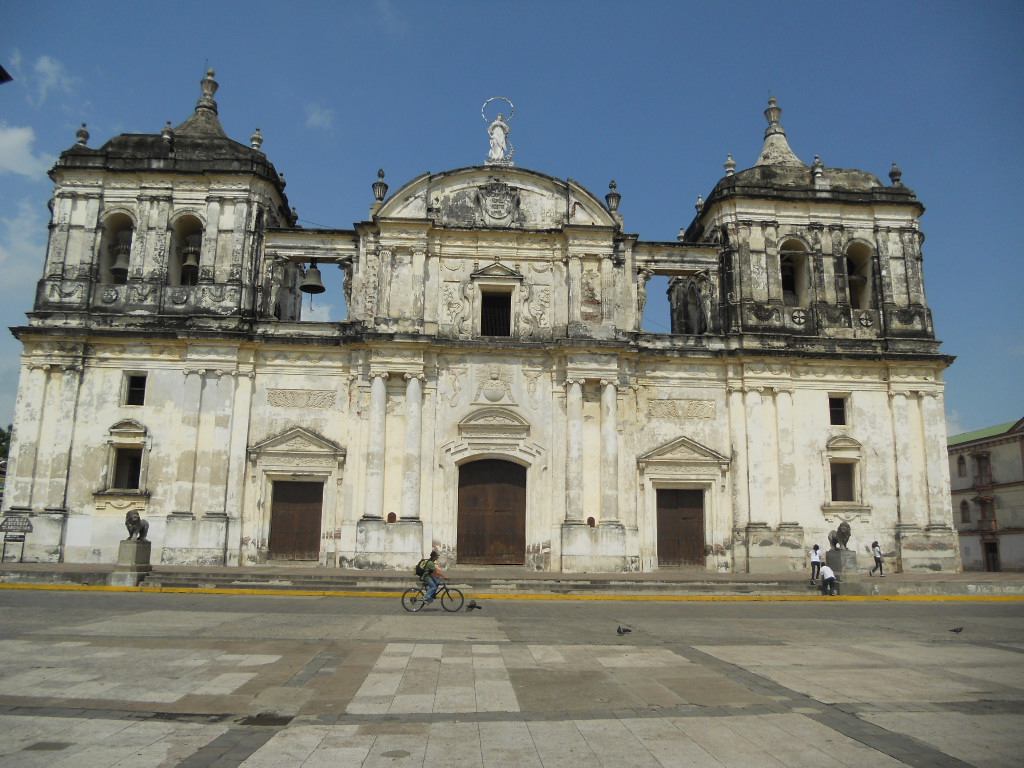
This is the biggest cathedral in Central-America and accroding to a story I heard it was supposed to be buildt in Lima, Peru and not in Leon, Nicaragua. It was approved for Lima because Lima was a much more important city for Spain, and in Leon, a much more modest onchurch was approved. The architect Diego Jose de Porres Esquivel, the Capitan General of Guatemala (he is also responsible for other beautiful and famous churches in the Americas) pulled a "switcheroo" and buildt this cathedral in Leon, and Lima got the modest one. The name of it is the Basilica de la Asuncionand, and it is the pantheon of Nica (Nicaraguan) culture. The tomb of Nicaraguas beloved son, the poet Ruben Dario is on one side of the altar, guarded by a sorrowful lion.
Streets in Nicaragua.
One very old church in Leon.
Nica heroes.
Inside the cathedral.
A beautiful church near the Parque central in Leon.
Suscribirse a:
Entradas (Atom)