Where am I

Mostrando entradas con la etiqueta fish. Mostrar todas las entradas

lunes, 10 de octubre de 2011

Animal encounters

 As I said before in a blog, the Cahuita National Park is also protecting an endangered reef near the coast. The reef is built up from over 35 species of corals including elkhorn corals and smooth brain corals   http://www.livestockusa.org/BRAINS.html
Elkhorn corals are actually in danger of diseases and death because of human feces (from sewage), according to a study done by the University of Georgia. The very important coral, that give shelter and food for countless species of invertebrates and fish, gained federal legal protection in 2006 along with stag horn corals, and are now even rared in zoos too save them. In 2008 there was also passed a law that prohibited all activity that would harm the reefs, but the reefs are still dying, leaving huge areas deserted. http://www.youtube.com/watch?v=Xw3ylqPxeuU
Snorkeling there is excellent, and during the dry season you can snorkle from the beach. Now it it rainy season, so I went out on a tour with a boat to do snorkeling at 3 points near Punta Cahuita. It was amazing. I saw a lot of colorful fishes, some that I had not seen before, and beautiful squids changing colors. After snorkeling we went to Punta Cahuita to have a lunch and a walk. We were 4 in my group, and had a guide for the walk. We met other groups of people there but the guides made sure that the groups kept apart. Below are pictures of snakes. On the first picture it is difficult to see the snake, it looks like the branches.
 

I really wanted to see a sloth, so I was so proud of myself (and count myself as an excellent animal finder ;) ) when I was the one that spotted something in a tree that the guide passed by. Sloths are difficult to see because they do not move much, and when I saw one, I was not sure if I really saw something worth seeing, but the guide confirmed that it was indeed a sloth. Since I love so much writing about animal medicine (and psychology) I will create a blog about sloth medicine, and some other animal medicine.We actually saw 4 sloths that day, and one them was a baby showing us how to give a good scratch. A troop of curious howler monkeys lay digesting their lunches in the trees.
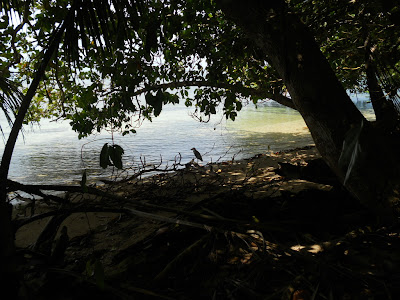
 We saw many birds and I photographed some, but unfortunately the camera I have now is not as good as the one I had. I saw 2 different species of vulture; black vultures and a king vulture (they are more beautiful looking). And the bird sitting by the water might be a heron. We swam over coral reefs and walked through lush vegetation, on a sandy beach, crossed a bridge over a mash and mangrove swamps. Can you find the snake on the picture below? Hint; it is yellow. It is a yellow eyelash viper, it is venomous (the most dangerous in Central America), found in Central - and South America, and they come in a wide variety of colors, I have seen pink ones. The eyelash viper is a mystery to the rain forest because of the 5 color phases. Many animals and humans are afraid of the ferocious looking snake, but fortunately it will never attack a human unless the human is stupid enough to attack it. And unfortunately that is why humans are bitten; when they see a snake, people in Costa Rica go for the head with a jungle knife, and that is when they are bitten. Apart from that they will only have an interest of attacking their food; small mammals, lizards, frogs and birds. The eyelash viper give birth to live babies (I have witnessed an eylash baby being born!), and once it crawls out of the mother it is quite capable. However I have read that there IS actually a little bit of child rearing going on; they learn from the mother for 2 months and during that time she will also protect them. The reason why it is called "eyelash viper" is because it has some small antena-look-alike structures above the eye that makes its head look like a flower from a birds perspective. So it is a camouflage that also helps the snake sneak up on a prey and quickly inject its venom. They can live for a year without food. Snakes are interesting because they dwell in so many places and come in so many colors, shapes and sizes. Snakes represents versatility, transmutation and change. Their natural behavior is to shed the skin and leave the old one behind, adapting to new ideas. Unfortunately the snake has gotten a bad reputation from the Bible, and is seen by many as evil or bad news. But in the older mythologies the snake is an icon for healing and spirituality. The snake is used as a symbol in the pharmacy industry. Snakes awaken spiritual and magical intuition in people.Snakes are associated with unseen creative forces at work. With the snake totem the powers of intuition and observation becomes keener and more precise. The combination of change and intuition will allow great new development in life and a proper instinct for deciding which changes will be effective. The snake is openness to new experiences and opened horizons. The snake totem possesses the following virtues: Wisdom, healing, intuition, awaking of creative forces, ability to change without resistance, new opportunities for change, material vitality, intellect, power over rashness in speech and thought, emotional control, increased sensitivity to the environment, increased power of observation.

A story I love to tell sometimes is about the time I stood half a meter from a rattlesnake in Bolivia. Rattlesnakes are also vipers, belonging to pit vipers. The only reason why I think it was a rattle snake was because it rattled. I was walking with "my" jaguar, Yaguaru in the jungle one day (I worked for the organization Inti Wara Yassi for 8-9 months in the Amason Basin in Bolivia), and on the way to his beach he suddenly stopped dead. I heard the sound of a rattle and saw a snake with its head and upper body lifted up, and it was between me and Yaguaru. Yaguaru stared at it in with huge, round eyes, but stood dead still, the snake did not attempt to strike, but it was clearly warning us. I was in quite a hopeless situation since both sides of the path had trees with spines, so there was no way of going around. Strangely enough I was not afraid, I was calm, thank God, and it kept Yaguaru from doing anything that would put us in danger. I did not think for one minute that the snake would bite me. It was hopeless for me to get to Yaguaru, for one he is a jaguar and you just do not jump, or step towards a jaguar when a snake is between you and the jaguar, so I had to make him come to me. I talked to him encouraging him to jump over to me, so I moved carefully backwards a little to make space for him. I also talked to the snake telling it that we just wanted to pass, and that I respect its space. I also told it that we would come back the same way, and that we were friends and thus would not harm it. I talked to Yaguaru and told him that the snake would not bite us, that we would be safe and that he had to trust me and come to me. In the end he made a big leap to my side and we continued to the beach. Maybe some readers will think that I am a "werido" who think I can talk to animals and that they understand. But they do understand everything. They are all soulful, intelligent beings, I know that because it was my daily life at that time, communicating with big cats, monkeys, birds, peccaries and coatis. I never thought for one minute that it would be fruitless to talk to a snake that was threatening to strike.


The beautiful spider on the picture below is the golden silk orb-weaver. The female is huge and the male looks like a tiny fly. He has a difficult job getting to the female and not being eaten. The male of spiders will send messages to the female by touching the treads of her web with his feet in a certain pattern when he is wooing her. This will send vibrations through her web that tells her that she is visited by a male, as opposed to a victim that has been caught in her net. The males interest is, of course, to mate with her, but sometimes the female decides that she is more hungry than in the mood for love, so she eats him in stead. Talk about girlpower! The females weave quite an impressive web, and they are noted for it because the web of a mature female can reach a meter in width. The treads are yellow, so they look like gold in the sunlight. If the male is successful, the female spins an egg sac on a tree and lay hundreds of eggs. If you are bitten by one you will experience local pain and redness from its venom. many people find spiders scary and repulsive. In animal medicine, and animal psychology, people are encouraged to look closely at animals they find repulsive or are very fearful of, because it also gives you an important message. The spider is linked with time, and in India with the Goddess Maya, the weaver of illusion. You may ask you self, if you fear the spider, am I in charge of my own life /destiny? Is there a balance between my past and my future? Physical and spiritual? Yin and yang? How do I look upon my future? The spider reminds us that we are the center and in the center of our own world, and this is how it should be, because only by knowing yourself first you can know the Universe. The spider is so fascinating that I want to write more about it. But I will stop here. Afraid of spiders or not, believe in spider medicine or not, they are a blessing to this planet in so many ways. For one they control the bug population. 

"Humankind has not woven the web of life. We are but one thread within it. Whatever we do to the web, we do to ourselves. All things are bound together. All things connect."
~Chief Seattle~

Punta Cahuita in the background. On the path we would also meet some interesting ants called "limpiadores", cleaners. The reason is because they clean. They march out in the jungle in big armies and carry away everything that is dead. The guide told us that they will occasionally come into peoples houses in huge numbers, and the only thing the person can do is to leave the house for a few hours and let them do what they have come to do. Clean! Dead animals and pieces of food lying around in your house will be carried out. The reason why you better leave them there to do their job is that if you get in their way, their bite can be quite painful. On the picture below; our boat for the day (the bluish greenish one).   

martes, 6 de septiembre de 2011

A week in Communidad Jiquilillo

This little boy on the horse asked me to take a picture of him, he is from the Communidad Jiquilillo, Northeast Nicaragua where people live from fishing and looking for clams in the mangrooves. The dogs are Nates dogs. According to Nate Curly, the big one, adopted him, and then later the smaller one Mojambles. They did me the honour of walking with me on a 3 hours adventure in the community and the long beachstrech between La Reserva Natural Padre Ramon and Nates Ranch.

Leon was WAY to hot for me so I decided to go to the north coast of Nicaragua to visit a small community named Jiquilillo (pron.; heekeeleeyo) by the beach. In fact it is an endless beach, with this pretty fishing community, along the stretch of dust road, that remaines underdeveloped. It is beautiful, and accessible from Leon by minivan /minibus, that leaves only when it is full to Chinandega, the cost is 20 cordoba ($ 0.75), take a taxi to the marked (10 cordoba), and then the chickenbus, 18 cordoba, on to Rancho Esperanza (or tell the helper to stop at "el Rancho de Nato") for a place to sleep while you are visiting the community. Another option is Rancho Tranquillo owned by Tina the "gringa". I have heard she is the happiest person in the world, as she has found her paradise here in Jiquilillo. Nate is another foreigner, from Maine, USA, who came to this place when he was just 18 to do volunteer work, in 1998. Because of lack of fundings the project was stoped before it was supposed to, but Nate continued working, improving health care for the community by spending his own money. When his money run out he went back to the US, and was able to come back in 2002. He has now lived in Jiquilillo almost 8 years, and on his Rancho he teaches children English for free, has an after school club, and takes in volunteers to work with him in the community. A lot of the money that he earns from the visitors to his ranch he spends to improve the health and education of the children. The same is true for Tina, and they are the 2 happiest people on this planet. People that I have met on this travel are certainly not people you run into every day, and it almost makes me ashamed to think about HOW MUCH we can do as individuals in this world if we snap out of our own selfpitty in the rich and comfortable corner of the world. And by doing so, we will improve our own lifes a lot. There is certainly no need for an organisation or other people to take an initiativ, there are enough people like KumiNicaragua is the poorest country in Central-America, and one of the poorest in the world but I find the people here very lovley and friendly. The women here are STRONG, I am not the only one who has noticed, and in Nates place I met Fabienne from France and William from Australia. We had a lot of good talks about culture, history, religion, and other fun subjects. William said that the women of Nicaragua are very, very strong, and at the same time very humble (what I noticed from Miraflor). In Australia the women are so proud, he told me, and he said that he has no idea why they are so proud. What do they have to be proud of, he asked. I have always felt that there is something missing, that I have never been told or thought when I see the female powers and qualities at work in theese women. I remember seeing the same in Asia in the women there; that glowing from within, they have this secret, and they know something. Something mysterious and powerful that I really, really want to know too. The thing that I know excists inside me, but never learned how to tap into. You can see it in their eyes, and often also in their face, and you feel it when you are with them. The soul of the people here is very, very strong and beautiful, and this is what makes people from the west fall in love, and not wanting to leave again. So many people have Nicaragua as their favourite country, and I met a different kind of travelers here than in Guatemala. For one, this country is flooding with German girls. I have a feeling that for every German man I meet like 6 German women. It seems to be an attractive country for Europeans. So they stay, and their joy is to interact with the people, and Nicaragua is so cheap you will not even believe it.
Several km. of dust road goes through the community with houses on both sides. At the end of the road you reach the mouth of the Reserva Natural Estero Padre Ramos that is the main attraction here, it takes about an hour to walk slowly. Busses are scarce, just 4 during the day (2 in the morning and 2 in the afternoon), so you might be able to take the bus one way, but not the other if you do not plan good. There are local resturants at the end of the road, and the mouth of the delta is a safer and nice place to swim. The Pacific Ocean itself is crashing in on the endless beach, and the currents and swells might be too forceful to swim comfortably in many places. You can also pay a visit to the crocodille project behind the school, talk to the locals, gride a horse and go kayaking with David, the best guide in the mangrooves. The fishdishes you get at the resturants are super delicious, and the fish is brought in by the local fishermen, that harvest from the sea without harming the environment. Unfortunatley the treat comes from the more developed and industrialized countries El Salvador and Honduras whom have already fished their coasts empty of fish and want to start fishing in Nica territory.


A walk on the beach during high tide made me have to wade some of the way. The waves were crashing forcefully in on the beach. There had been a typhon somewhere that made the swell very high while I was there. Several houses had to be evacuated because of the swell, it is weird that in a few days a lot of this was under wather during the nights, palm trees fell down and people left their houses 03:00 pm.
To spare the environment, Nate has installed theese dry eco-toilets. The instruction is; after makeing your DEPOSIT fill a bowl with the sawdust to cover it. Always put the lid down. Under is the common eating hall.


miércoles, 17 de agosto de 2011

Visiting the biggest lake and a waterfall in Honduras

The beautiful Pulhapanzak Falls is 20 min. by bus from Peña Blanca is the highest waterfall in Honduras and quite impressive. The bus from Los Mochis can also take you the falls, it will pick you up by the dirtroad to D&D (more about D&D further down), direction San Pedro Sula. Tell the helper on the bus that you want to go to the waterfall and they will let you off by the road up to the park and point you in the right direction. If you do not know the Spanish word do not worry, tourists get of either there or in San Pedro Sula so I am sure they will understand where you want to go. The waterfall is a short but hot walk from the main road, or you can get a taxi. At the fall there is a resturant some guides and activities. You can get a tour inside /behind the fall, swim in the pool that forms above the waterfall, be careful, some places are deep, but it is amazing for cooling down when the heat is on.     


At Lago de Yojoa the biggest lake in Honduras (89 km2), I stayed at D&D Bed and Breakfast and Micro Brewery owned by a young man from USA. He had already lived and worked in Honduras for 5 years when he discovered Peña Blanca and decided to stay. D&D stands for Dale and Dog, but I never saw a dog there. Bobby (Robert Dale) has his own brewery at the place where he experiments with different tastes of beer. He has, among other flavours, apricot beer! I am not knowlegeable about beer, but the second day I was at his place, some USA soldiers, that have their base nearby, visited the place to eat, and have some homebrewed beer, kept buying beer for me and 2 German girls that I went to the waterfall on the picture with the same day. I do not like beer to begin with, so I can not judge, but I know that his beer and place is very popular, and has a steady stream of travelers and locals. D&D is famous in the area, so getting of the bus in Peña Blanca (1,5 h. - 2 h. from San Pedro Sula and 3 h. - 4 h. (because the buses are unbeliveably slow. It is not so far in distance) from Comayagua), all you have to do is ask for D&D and the locals will tell you where to wait for a collectivo taxi (in which you will sit crammed together with as many as they can fit in the car for 5 lempiras (50 cent, ca. NKr. 3)). Or if you are on a bus to Los Mochis (most likely a chickenbus), you just have to ask them to drop you off at D&D. Walk up the small dirtroad, and you will see it. D&D offers everything from jacusicabana (750 lempiras (Lps)) to cheap dormbeds for 100 Lps. And of course beer! They also have a meny, not many dishes on the meny, but the blueberry pancake for breakfast was my favourite. The homemade burritos and kebab is also worth it, and he has a beautiful garden where I observed 3 species of hummingbirdsand weird insects. Even if D&D is located in a communety 3 km. outside Peña Blanca, staying there acctually gives better access Lago de Yojoa (Lake Yojoa). If you should ever find yourself in Honduras, it is SO worth it seeing other places than Copan and Utila. Most people miss out on a lot, and it seem to me that many people are also afraid of Honduras. They rather follow the tourist trail to Copan and Rotan and /or Utila and then get out of the country. I also had that fear, because I got robbed and heard stories, but I decided to not let that dictate my travel. And I have to tell you, that the day I swam in the lake, I thought to myself; I feel sorry for the travelers coming to Honduras never seeing this lake! It has been a long time favourite among bird lovers because it has been recorded 375 species of birds around the lake. I myself saw cranes, ibis, snail kites and various ducks, and went swimming in this wonderful, sometimes mist-shoruded, lake. I thought Lago Atitlan was beautiful, but I must say (even if Lake Yojoa lacks the vulcanos) that Lake Yojoas pristine and pure natural surroundings with the Santa Barbara mountains and quietness was much more revarding. There are no motorboats, no villages in sight. I had the feeling of venuring to an almost utouched area. It might change in the future because it will become a tourist hot spot, but hopefully it will stay the way it is for a long time. In the area there are of course 2 national parks; Cerro Azul Meámbar and Santa Bárbara, as well as the 2 eco-archaeological parks; Lenca and Los Naranjos, and the impressive Pulhapanzak Falls. From D&D it is only a 15-20 min. walk to the canal where you can rent a rowboat (and prefereably a rower since it is very hard to do the rowing on your own, it is also a bit far to the lake. The heat makes it twice as hard) to go rowing and swimming in the lake it is the best way to see the lake because if you are not on it you will not see the beautiful mountainviews revealing themselves as the lake opens up at the end of the canal. It is beautiful also at sunset and sunrise. If like you like fishing then the lake is a perfect place to catch brass, and you can get a guide from D&D to take you.

                                 Lenca eco-park and paradise. Coffe and flowers.

                                Lenca eco-park
                                Lake above the waterfall where we swam.
                                             Pulhapanzak Falls


lunes, 8 de agosto de 2011

Utila Cays and moving on

From Utila I went to a tiny island, or more like a giant flat stone in the ocean, called Pigeon Cay. I went there with Capitain Morgans diving schools boat out there to learn how to dive. The only way to get there is by boat, it takes about 20 min. from Utila. A tiny, tiny cay with less than a 100 houses clung together. It is so flat that just half a meter waterrise will cause flooding, and indeed all the houses are on stilts. I guess they are used to flooding during the rainyseason. The people on the cay live from fishing on the coral reefs, and are, in that sense, totally dependent on the health of the coral reefs that are teeming with interesting life; beautiful seacreatures. An underwaterworld of colours and varaity. I did not know if I wanted a diving license, and because of limited time after the robbery, I just did a day of discovery dive. In Utila there are several options for diving and snorkeling. I got to see a lot of underwater life anyway; rays, parrotfish, squids, small eels and snakes and a lot more. My big wish is to see the whaleshark, but I never saw one. Some day I will see them, and snorkle with them!

Since I am heading for Nicaragua it was time to move on after a few days as an islander. I took the passengerferry Utila Princess II at 06:20 in the morning, thinking that the sea would be calm at that time, like it was when I went to Utila. But in the line in front of me I heard people asking for seasickness pills, so I thought that maybe it would be a "bumby ride". Since I am not traveling by boat a lot, I am never sure how seasick I will be. I thought that they are Honduran landcrabs and maybe they just want to be sure that they did not get sick. The sea was really rough on the way to Ceiba, but I sat outside on the back of the boat. I am glad I did that, inside is just a big room for the passengers. The "capitan" and his co-workers are standing in the front, and it smells of oil and engine. The waves were big, but kind of gentle, so even though it would be hard walking around, I did not have the feeling that the boat was beeing tossed around. Sitting in the back I did not see much, just a narrow oceanview to were we came from. It was not possible to see what was going on in the front of the boat. I figured that was just as good, but I had confidence in the "capitan" and the ferry, I knew that if it is too rough the ferry would not leave the dock. Sitting here by Lago de Yojoa, I meet people, that just came from Utila, telling me about a lot of people getting so seasick that they were throwing up. I do not know if there was anyone throwing up when I did the trip, but I saw some people looking a bit pale. I was even more happy that I sat outside, even if I got splashed.

When I got back to La Ceiba I took a taxi (50 lempiras = 15-20 Nkr.) directly to the busstation where I bought a ticked with Diana Express to Tela. Tela is supposedly a very nice city, it is famous for its Carrebian beaches, but to me it was a bit waste to go there, I had had enough of beaches, and it was so hot and humid that I felt totally knoked out. There are two big national parks there to visit. But one thing about Honduras; it is difficult to travel alone. Not because it is difficult to get around, but everything gets more expencive, and not possible to do. All tours need a minimum of people, and Honduras is still an untouched and pristine country. It has not been taken over by mass tourism yet, there are national parks on every corner, and I have to say that naturewise Honduras is more green and beautiful than Guatemala. Traveling in Guatemala you see scars in the nature everywhere. It feels very populated and the nature is interruptet by buildings and villages everywhere, except in the national park of Peten. If you travel in Guatemala, thinking the nature is beautiful, and love it, you will LOVE Honduras. Now during the rainyseason it is so lush and green, and the hills and mountains are stunning. Going by boat out of La Ceiba you even see the slopes of the hills and mountains ending in the sea.


Pigeon Cay, part of Utila Cays by Utila Island outside Honduras. See map by clicking location under keywords.


Anyway, I spent 2 nights in Tela feeling like I was in a detoxprogram. And my skin is indeed softer. And in a bit of agony since I had been in the water and on boats so much on the cay that I was a bit sunburned. I left Tela for Lago de Yojoa, where I am sitting now at D&D bed and Breakfast and Brewery, 3 km from Peña Blanca. Here there are, of course, 3 eco /archeological /natureparks pluss the lake. The biggest body of water in Honduras. Yesterday I walked my feet of in the Eco Finca, a Eco-park with eco-coffeplantation, I saw a lot of birds (this is one of the places birdwatchers should visit), even tucans, and there are beautiful flowers, small creeks and rivers that I could have swam in, but I did not know.  I also visited a waterfall. More in the next blog.