It is not possible to go to Costa Rica without the proper music! Actually at the Caribbean Coast that should be Bob Marley, but since everything goes, and there is a good blend (like, right now I listen to Indian music at Cafe Rico (where I have eaten the best Indian food outside India!), by the former named coast by the Caribbean Sea), I take a chance on Yeah Yeah Yeahs, because I just think that the girl is cool, and they will always remind me of CR.
Unfortunately Costa Rica is not the most cheap place, it is like living in Europe, and with bad salaries. I do not really understand how people get along here, and how they can buy stuff. The cost of living is expensive, even in the super marked food is priced like Europe. But for all I know it is probably a small group in the population that do all the shopping. It is the most developed country since Mexico, and it is also statistically the most dangerous one. There are more crimes being done here than the rest of Central America, or so I have been told. I will check it out. It is very influenced by USA, it seems to me that fruit companies and fastfood chains has taken over a lot (I see something that is USA everywhere). I hope that in the future tourists will not find a MacDonalds on top of a volcano or in another tourist friendly national park. I HOPE they will be able to live up to their slogan: Pura Vida, because they are doing so far (apart from all the US fastfood). But the pressure from tourists that really need their air conditioning on their 2-3 weeks visiting CR, in their summer homes or in hotels (to gawk at the bountiful nature and the animals), is big, and so pristine rivers are in danger of being dammed to produce the electricity needed. In the meantime, a Tica (Costa Rican) lives his hot, humid life without air con. I have visited a home here, they are hot, but made with high ceilings, and underneath the ceiling it is open space with just a net to provide air throughout. This is the mahogany tree houses, they are similar to what I saw in Belize, I do not know how the adobe houses are, but I imagine they are similar to those I have seen in Mexico.
My 3rd day in CR I decided to go to see the volcano Irazu. It is a big volcano with a main crater of 1 050 m. in diameter and 300 m. deep. It is the highest volcano in the country, 3 432 m., and it is possible to see both the Pacific - and the Atlantic Ocean from here on a clear day. I could not see anything for the rain and the fog. Irazu means "thunder" in the native language of the natives that used to live by it. A catastrophic eruption in 1723 destroyed a city, then capital of the country, Cartago, and an eruption in 1963 covered San Jose in a thick layer of ash. People used to think that Irazu blows every 30 years and was called "the deadly keg of powder".
In CR there are more than 112 volcanic formations. They belong to the Pacific Rim of Fire, and 7 are considered very active. The volcanoes are responsible for the very fertile soil that covers the territory of CR. They have all caused some major damage in the past. The most active volcano is Arenal, and Poas has the widest crater of diameter 1.5 km, the 2nd widest in the world. In 1950 it was decided that the land around the volcanoes should be protected, so many of them are within a national park. Irazu has its own national park. The CR volcanoes are stratovolcanoes, which means that the magma that fuels them is thick, viscous, and so filled with gasses that when they erupt the magma blast violently into the air. In the eruption of 1963 the clouds of smoke erupted, and ashes kept showering over San Jose and other parts for 2 years. People had to go out with a hankerchief and every day 13 cm. of ashes was swept down. 24th of August 2000 Arenal erupted, killed 1 person and injured 2. 600 people were evacuated from their homes.
To go to Irazu you can take a bus from where the National Theater is. It leaves 08:00 in the morning and you go back with the same bus 12:30 so you will want to buy a round trip for 4000 colones (US$ 8 (much more than you pay to travel in Nicaragua. The bus ride takes 2 hours. On top there is a small cafe that sells pretty good hot latte (you will need hot coffe because it is really cold up there. At the coffe shop they sell different suveneirs, among other things a note book made from banana paper. I think that this paper would be better to use to spare the rainforest. Under; a lonley, familiar dandelion has found its way to the top of a volcano in CR.
Where am I
viernes, 7 de octubre de 2011
Volcanoes in Costa Rica
Etiquetas:
Caribbean Coast,
Caribbean Sea,
catastrophic,
Costa Rica,
crater,
eruption,
magma,
national park,
stratovolcano,
the Pacific Rim of Fire,
Tica,
volcano,
Volcano Irazu
Ubicación:
Volcán Irazu, Costa Rica
martes, 4 de octubre de 2011
A crazy border crossing
It was hard to decide to finally leave Ometepe. The old man at Hostal Central was an interesting person to talk to, and we discussed a lot of the things I like to discuss. Happy that I am not the only person thinking the way I do. He told me about his travels all over the world. Quite amazing that he has traveled so much considering that he is born to a tribe on the Island. That is what he claims any way. He knows a lot of secrets on the Island as well, and he was willing to share some.I went to a small museum (there are many of them), to see some of the things that farmers have encountered here while working on their lands. The items below are 2-3 000 years old vessels used for burial and food. They were beautifully decorated with images of animals, such as the jaguar, the monkey and bats, and painted with bright colours.

We reached the other side after an hour and the ferry was stormed by people looking for customers for their taxis. There was a bus to Managua on the dock, but no buses to Rivas or the border in sight. I made a deal with a taxi driver to drive me all the way to the border so that I could get there early. We were off right away and got to the border before noon. On the picture under is Ometepe from the mainland as the ferry docks.
When I came to the border it was very confusing. I had to go to one little booth to pay a fee and then bring a ticket for further inspection. I walked a few meters with people around me shouting; this way, that way, here, over there, everyone pointing me to the right direction of immigration, as it was far from obvious where I should go. My passport had to be shown to some guy, along with the ticket that proved that I had payed the fee. Then some walking again and I was at the immigration (on the Nicaraguan side) where I had to show my passport yet another time, get it stamped, show the proof that I had payed the fee, and then pay a fee again. Since it is a good km. or more to walk to the Costa Rican border I hired a tricyckle taxi. A young boy was working his way with me and my stuff on the seat on the front of the tricycle. As I sat there, already flustered and sweating from the heat and ordeal, a man came walking towards us complementing me on my beauty (something that made me laugh because my hair was plastered to my head, and my garments were sticking to my body), another man pased with a: "hola linda!" and after a few more meters a young man smiled and winked. At that I almost bended over from laughter, and made the young boy who got me to the border, laugh as well. Bless these men for trying to make me feel like an attractive woman even in my darkest moments! He stopped by a lot of small shacks and buildings and told me that here is Costa Rica and he could not cross. Again, after putting on my backpack and gathering my things, I had to put everything down again right away when I was requested to show my passport, AGAIN! Then I had to walk, and I walked, and I walked. Maybe a km. or something.It was far to the immigration. I was very nervous, because you should show a ticket out of Costa Rica to enter, something I did not have. I had not even filled out one of those white papers with questions of where you are from, purpose of visit and next destination and so on.I was dreading the worst when I said that I did not have the white piece of paper, but the clerk just waved his hand, took my passport and asked; "so, Linda, how long are you planning to stay in Costa Rica?" I said that I was only staying for a few days before moving on to Panama. He stamped my pass and sent me on my way. Then I walked to a booth, bought a busticket to San Jose, and waited an hour for the bus. (San Jose on the pictures below)
It is only 300 or something km. to San Jose, and it should take 5-6 hours, at least with the speed the youngster that drove the bus was going. I was sure at certain points that he was on a mission to kill us all. I was used to tranquil Nicaragua and Honduras with much less traffic on the roads. So the first experience of CR was a bit disturbing. The traffic in CR is very heavy and the roads are as narrow, and underdeveloped as the almost carfree (compared to CR) Nicaragua. It took had us 9 hours to get to San Jose, and by that time I was really tired and had been tested on my patience. We had had to stop a couple of times for 20 min. because of work on the roads, and we had a 10 min. stop to go to the toilets and get some food at a truck stop by the road. It was dark and late when we came to San Jose. Dazed and hungry I took the first taxi i could find to Backpacker Hostel Tranquilo in the heart of San Jose. I shared the room with a man from Chile that workes in San Jose and 2 women from Germany that where on their way home to Germany. After a good nights sleep I went out exploring San Jose. It was a bit weird coming to a big, busy city after the quiet Nicaragua. But I liked it. I found some cafes with organic food and vegetarian food. San Jose seem to have a lot of great shopping, but do not expect to get things cheaper than in Europe. I visited the cathedral while there was a sermon with some priests dressed in their most magnificent and expensive robes. In CR everything is Pura Vida. It is a very ecologically aware country, the only thing that is a pity here is that I was back in the land of Pizza Hut, Taco Bells, MacDonalds and Burger King. Hardly anyone will agree that these 4 food companies have anything to do with Pura Vida (a Pure Life), but still they are plentiful here.
I woke up early to take an early ferry to the mainland again so that I could cross the border to Costa Rica early. I saw the ferry called Che Guevara lying there and thought that I was going with that one. But I returned with the same ferry as I came with; Ferry I. I ate my breakfast at Cornerhouse to say good bye to Gary and Sara, and have a last iced latte. Then I went to the ferry where I talked to some local boys while I waited. And soon the ferry had emptied the cars (an amazing number for a tiny ferry like that) and was ready to return to the mainland. The ferry loaded on only 2 trucks and we were off. It was a little bit rocky on the way over, but I was standing outside in the front and got some last pictures of the island from the ferry.
We reached the other side after an hour and the ferry was stormed by people looking for customers for their taxis. There was a bus to Managua on the dock, but no buses to Rivas or the border in sight. I made a deal with a taxi driver to drive me all the way to the border so that I could get there early. We were off right away and got to the border before noon. On the picture under is Ometepe from the mainland as the ferry docks.
When I came to the border it was very confusing. I had to go to one little booth to pay a fee and then bring a ticket for further inspection. I walked a few meters with people around me shouting; this way, that way, here, over there, everyone pointing me to the right direction of immigration, as it was far from obvious where I should go. My passport had to be shown to some guy, along with the ticket that proved that I had payed the fee. Then some walking again and I was at the immigration (on the Nicaraguan side) where I had to show my passport yet another time, get it stamped, show the proof that I had payed the fee, and then pay a fee again. Since it is a good km. or more to walk to the Costa Rican border I hired a tricyckle taxi. A young boy was working his way with me and my stuff on the seat on the front of the tricycle. As I sat there, already flustered and sweating from the heat and ordeal, a man came walking towards us complementing me on my beauty (something that made me laugh because my hair was plastered to my head, and my garments were sticking to my body), another man pased with a: "hola linda!" and after a few more meters a young man smiled and winked. At that I almost bended over from laughter, and made the young boy who got me to the border, laugh as well. Bless these men for trying to make me feel like an attractive woman even in my darkest moments! He stopped by a lot of small shacks and buildings and told me that here is Costa Rica and he could not cross. Again, after putting on my backpack and gathering my things, I had to put everything down again right away when I was requested to show my passport, AGAIN! Then I had to walk, and I walked, and I walked. Maybe a km. or something.It was far to the immigration. I was very nervous, because you should show a ticket out of Costa Rica to enter, something I did not have. I had not even filled out one of those white papers with questions of where you are from, purpose of visit and next destination and so on.I was dreading the worst when I said that I did not have the white piece of paper, but the clerk just waved his hand, took my passport and asked; "so, Linda, how long are you planning to stay in Costa Rica?" I said that I was only staying for a few days before moving on to Panama. He stamped my pass and sent me on my way. Then I walked to a booth, bought a busticket to San Jose, and waited an hour for the bus. (San Jose on the pictures below)
It is only 300 or something km. to San Jose, and it should take 5-6 hours, at least with the speed the youngster that drove the bus was going. I was sure at certain points that he was on a mission to kill us all. I was used to tranquil Nicaragua and Honduras with much less traffic on the roads. So the first experience of CR was a bit disturbing. The traffic in CR is very heavy and the roads are as narrow, and underdeveloped as the almost carfree (compared to CR) Nicaragua. It took had us 9 hours to get to San Jose, and by that time I was really tired and had been tested on my patience. We had had to stop a couple of times for 20 min. because of work on the roads, and we had a 10 min. stop to go to the toilets and get some food at a truck stop by the road. It was dark and late when we came to San Jose. Dazed and hungry I took the first taxi i could find to Backpacker Hostel Tranquilo in the heart of San Jose. I shared the room with a man from Chile that workes in San Jose and 2 women from Germany that where on their way home to Germany. After a good nights sleep I went out exploring San Jose. It was a bit weird coming to a big, busy city after the quiet Nicaragua. But I liked it. I found some cafes with organic food and vegetarian food. San Jose seem to have a lot of great shopping, but do not expect to get things cheaper than in Europe. I visited the cathedral while there was a sermon with some priests dressed in their most magnificent and expensive robes. In CR everything is Pura Vida. It is a very ecologically aware country, the only thing that is a pity here is that I was back in the land of Pizza Hut, Taco Bells, MacDonalds and Burger King. Hardly anyone will agree that these 4 food companies have anything to do with Pura Vida (a Pure Life), but still they are plentiful here.
Etiquetas:
border,
bus,
Costa Rica,
cross border,
Isla de Ometepe,
island,
Nicaragua,
organic food,
vegetarian food
Ubicación:
San Jose, Costa Rica
miércoles, 28 de septiembre de 2011
Bikeriding on Ometepe Island
To keep myself active when I came back to sleep in Hostel Central in Moyogalpa (or Indio Viejo), I rented a bike one day to explore the island. You can rent one from the "old indian" himself for $6 a day, or from others for $5. You always have to check the brakes, or else you may get a nasty surprise. The day wI decided to do so I met Scot from UK who was also after a bike for the day. I decided to bike to Balgue on the other side of the island, and stop a few places on the way. The first stop was at Punta Jesus Maria, the locals call the Whales back because there is a small strip of land going out into the lake, however the lake is now so full of water that it was not possible to see the strip of land called the Whales back. The picture above is a picture of the road down there. It is 1 /2 km. from the main road. The picture below is as far as I got.
The picture below is from Laguna Chaco Verde, and it is also a bit away from the main road. it is possible also to sleep in a hotel near this lagoon, called Chaco Verde. By the entrance to Chaco Verde, the main road (from Moyogalpa on the Conception part of the island, to Altagracia on the Maderas side, the only paved road on the island) start to go up hill, so you might want to either take the bus to the junction that connects the two parts of the island, or you can stop and take a refreshing bath here before continuing, under an unmerciful sun, to take a bath. It is really quiet and beautiful, no people around when I was there, and you can see /hear howler monkeys and see both Conception and Maderas from there. The water is clear and refreshing. m o this was my 2nd stop on the way to Balgue, some 20 or more km. from Moyogalpa (for the record, I do not know how far it is, but when I came back i was told that I had been bkiking more than 40 km. (not including my stops)). The 2 pictures below are from the lagoon Chaco Verde.
From Chaco Verde I had a really hard time getting up several km. up hill with my bike. I had to get up and walk some. The sun makes it really hard since there are no trees to give any shade. It is not a steep hill, but it
is hard (on the way back it is fun though!). After climbing all those km. the road went slightly down hill toward the junction where I would take off towards Balgue. Right after the junction there is a very steep down hill, and at the bottom is the entrance for Ojo de Agua, a source of water that is, thought by the natives, to be healing water. I went past it because the hill was steep and I had good speed on my bike. I was really grateful that it is hardly any traffic on the island, because the roads are small and narrow. I went on to Balgue, the road was a bit easier, until you get to the unpaved road part. The Maderas side of the island is less developed than the Conception side, so the roads are awful and bumpy, and the only reason why buses take forever to travel a few km. I stopped to drink a juice in Balgue and started back, determined to stop at Ojo de Agua on the way back. I was tired when I came there because I had to bike up hill a lot, so it was just beautiful to lie down in the rather cold water. Ojo de Agua (eye of water) is caused by rainwater that was stuck underground in the soft volcanic sediments being pressed up again to the surface. During the rainy season the water seeps down in the hollows in the rocky ground and in the end there is too much water, so it presses up again where it can find a way out, and it makes the pool on the pictures (below), and a river running in to the lake from it. Because it has been trapped before inside volcanic ground full of minerals, the water is crystal clear and sparkling clean, and full of minerals. That is why it is healing water, and it is said that a bath in the water makes you 5 years younger. So while I was there, I jumped in 3 times, and I made jokes to a man and a woman I met that I am 15 years younger, since I jumped in 3 times. I ate some food by the pool, and swam in it in between. It is not very deep, and compared to Lake Nicaragua, the water is very cold, but in the heat you will appreciate it. After almost 2 hours, I considered going back because it gets dark so early, and even if there is little traffic, I did not want to bike in the dark. To get back was first very, very hard. I was tired from all the up hill climbing that I had done, and I am not a champion on bike. When the up hills started by Chaco Verde, Scot left me (he was on a day trip to the island, and was going to go back to the mainland on the 17:00 boat), and I met him on the way back when I was nearing Balgue, we said goodbye and he went back before me. I had my battle with all the up hill until I came to the point where it all went down for several km., and it was tons of fun. Just sitting on the bike, not having to nothing was a blessing, my princess ass was hurting from an uncomfortable seat, so I was in heaven for a while. After all the down hill, I joined locals, that travel by bike all the time here, but have all the time in the world biking lazily away. I, also, biked lazily away. After something that seems like forever with my sore ass, I finally got back home. The 2 pictures below are from Ojo de Agua.
I managed to stay on Isla de Ometepe for 2 weeks. It was difficult to leave, and more than one person said; the island does that to you! And now it is experiencing its 3rd. invasion. The 1st. invasion was the aztec invasion, the 2nd. the conquistadors from Spain, and the 3rd is the Europeans and the USA. On this small island, the foreign population is growing. I met many, f.ex. one young couple from UK running the Cornerhouse Cafe. They make the most delicious Eggs Benedict you can find in the whole wide world! And the cold latte and carrot cake is also to die for. I made the place my regular place the week I spend in Moyogalpa, sitting there whole days sometimes to catch up on my blog, eating breakfast (Egg Benedict) together with one of the refreshing smoothies with starfruit or passion fruit together with mango and papaya, mango and banana, or banana and papaya, or some other fruits. Then have a iced latte and a carrot cake or an organic vegetarian sandwich. I met other Europeans and people from US in the cafe who either lived there or had just bought a property there. The reason to leave their countries where very interesting, so I had some very meaningful conversations with some of them. In general they do not have a "mainstream" philosophy of life. The locals on the island are so beautiful that I could almost cry looking at them. But I guess it is easy to be beautiful when you live a stress free, simple life and have clean air and surrounded by green nature and animals. Me and Rei-Han (from Taipei) had a conversation about that, and she said that the people are so beautiful because they are so pure in their hearts. She also said something interesting about happiness that gave me an idea, because I want to do a blog about happiness, so I have been thinking for a while about how to dig deeper into the theme. What I have noticed is that people in general seem happy in Central-America, not for lack of suffering, but maybe because of it, they take every moment as a chance of happiness. A friend said that they can not waste the time on unhappiness because they never know what will happen to them, and they live in countries with violence. What is happiness to them, is not the same as happiness is for us in the safe privileged world, but it works in the same way.I have long ago figured out that the way to true happiness is to grateful. And I am truly grateful for meeting all the people I have met, and to have come here to learn.
The picture below is from Laguna Chaco Verde, and it is also a bit away from the main road. it is possible also to sleep in a hotel near this lagoon, called Chaco Verde. By the entrance to Chaco Verde, the main road (from Moyogalpa on the Conception part of the island, to Altagracia on the Maderas side, the only paved road on the island) start to go up hill, so you might want to either take the bus to the junction that connects the two parts of the island, or you can stop and take a refreshing bath here before continuing, under an unmerciful sun, to take a bath. It is really quiet and beautiful, no people around when I was there, and you can see /hear howler monkeys and see both Conception and Maderas from there. The water is clear and refreshing. m o this was my 2nd stop on the way to Balgue, some 20 or more km. from Moyogalpa (for the record, I do not know how far it is, but when I came back i was told that I had been bkiking more than 40 km. (not including my stops)). The 2 pictures below are from the lagoon Chaco Verde.
From Chaco Verde I had a really hard time getting up several km. up hill with my bike. I had to get up and walk some. The sun makes it really hard since there are no trees to give any shade. It is not a steep hill, but it
is hard (on the way back it is fun though!). After climbing all those km. the road went slightly down hill toward the junction where I would take off towards Balgue. Right after the junction there is a very steep down hill, and at the bottom is the entrance for Ojo de Agua, a source of water that is, thought by the natives, to be healing water. I went past it because the hill was steep and I had good speed on my bike. I was really grateful that it is hardly any traffic on the island, because the roads are small and narrow. I went on to Balgue, the road was a bit easier, until you get to the unpaved road part. The Maderas side of the island is less developed than the Conception side, so the roads are awful and bumpy, and the only reason why buses take forever to travel a few km. I stopped to drink a juice in Balgue and started back, determined to stop at Ojo de Agua on the way back. I was tired when I came there because I had to bike up hill a lot, so it was just beautiful to lie down in the rather cold water. Ojo de Agua (eye of water) is caused by rainwater that was stuck underground in the soft volcanic sediments being pressed up again to the surface. During the rainy season the water seeps down in the hollows in the rocky ground and in the end there is too much water, so it presses up again where it can find a way out, and it makes the pool on the pictures (below), and a river running in to the lake from it. Because it has been trapped before inside volcanic ground full of minerals, the water is crystal clear and sparkling clean, and full of minerals. That is why it is healing water, and it is said that a bath in the water makes you 5 years younger. So while I was there, I jumped in 3 times, and I made jokes to a man and a woman I met that I am 15 years younger, since I jumped in 3 times. I ate some food by the pool, and swam in it in between. It is not very deep, and compared to Lake Nicaragua, the water is very cold, but in the heat you will appreciate it. After almost 2 hours, I considered going back because it gets dark so early, and even if there is little traffic, I did not want to bike in the dark. To get back was first very, very hard. I was tired from all the up hill climbing that I had done, and I am not a champion on bike. When the up hills started by Chaco Verde, Scot left me (he was on a day trip to the island, and was going to go back to the mainland on the 17:00 boat), and I met him on the way back when I was nearing Balgue, we said goodbye and he went back before me. I had my battle with all the up hill until I came to the point where it all went down for several km., and it was tons of fun. Just sitting on the bike, not having to nothing was a blessing, my princess ass was hurting from an uncomfortable seat, so I was in heaven for a while. After all the down hill, I joined locals, that travel by bike all the time here, but have all the time in the world biking lazily away. I, also, biked lazily away. After something that seems like forever with my sore ass, I finally got back home. The 2 pictures below are from Ojo de Agua.
I managed to stay on Isla de Ometepe for 2 weeks. It was difficult to leave, and more than one person said; the island does that to you! And now it is experiencing its 3rd. invasion. The 1st. invasion was the aztec invasion, the 2nd. the conquistadors from Spain, and the 3rd is the Europeans and the USA. On this small island, the foreign population is growing. I met many, f.ex. one young couple from UK running the Cornerhouse Cafe. They make the most delicious Eggs Benedict you can find in the whole wide world! And the cold latte and carrot cake is also to die for. I made the place my regular place the week I spend in Moyogalpa, sitting there whole days sometimes to catch up on my blog, eating breakfast (Egg Benedict) together with one of the refreshing smoothies with starfruit or passion fruit together with mango and papaya, mango and banana, or banana and papaya, or some other fruits. Then have a iced latte and a carrot cake or an organic vegetarian sandwich. I met other Europeans and people from US in the cafe who either lived there or had just bought a property there. The reason to leave their countries where very interesting, so I had some very meaningful conversations with some of them. In general they do not have a "mainstream" philosophy of life. The locals on the island are so beautiful that I could almost cry looking at them. But I guess it is easy to be beautiful when you live a stress free, simple life and have clean air and surrounded by green nature and animals. Me and Rei-Han (from Taipei) had a conversation about that, and she said that the people are so beautiful because they are so pure in their hearts. She also said something interesting about happiness that gave me an idea, because I want to do a blog about happiness, so I have been thinking for a while about how to dig deeper into the theme. What I have noticed is that people in general seem happy in Central-America, not for lack of suffering, but maybe because of it, they take every moment as a chance of happiness. A friend said that they can not waste the time on unhappiness because they never know what will happen to them, and they live in countries with violence. What is happiness to them, is not the same as happiness is for us in the safe privileged world, but it works in the same way.I have long ago figured out that the way to true happiness is to grateful. And I am truly grateful for meeting all the people I have met, and to have come here to learn.
Etiquetas:
animal,
aztec,
bike,
bikeriding,
conquistadors,
grateful,
happiness,
healing water,
howler monkey,
Isla de Ometepe,
island,
lagoon,
Lake Nicaragua,
nature,
Ojo de Agua,
passion fruit,
starfruit
Ubicación:
Rivas, Nicaragua
sábado, 24 de septiembre de 2011
On horseback to the slope of Maderas
After one day of relaxing, swimming and reading books at the Rancho Merida, we went to Haris (a German man with horses for rent) place to ask about horseback riding. We agreed on coming back at 9 the next morning for a 3hour tour on the slopes of the Volcano Maderas, on the way to Haris place we saw a howler monkey, birds and a snake with suspicious colours slithered over the path. The colours are those of dangerous snakes, but there are imposters, so I am not sure if it is a dangerous snake or an imposter.
The day after we turned up before 9 in the morning and got horses, I had told them that I really, really want to run, to gallop with a horse is like flying the moment they lift all their legs, and I want to feel it again. I think I need to take riding lessons when I get some money! My horse is the grey one and called Marihuanito, our guides horse is Pinto and Rei-Hans horse is Pimento. I got Marihuanito because he likes to run a lot, however it was difficult to run since we were going up into the woods, balancing on rocky ground and slippery paths. So we went slowly up on the slope of Maderas to a point where we could get an overview (the picture below). From there w could see the isthmus with the lake on both sides and the Volcano Conception shrouded in clouds. Granda is on the right side of the volcano on the main land, but it was difficult to see all the way to Granada because of the hazy sky. We could see Costa Rica in the south (not in the picture).
On the way back down we took another way and ended up in el Comminidad Merida where the school is, and most people live. Down there on the road we let the horses run for a while, and went down to a beach named Cabalito where the horses enjoyed cooling down in the water. Sitting on the horse the guide warned ut that they like to lie down with saddle, rider and everything, so we had to be prepared to get wet. The guide was carrying my camera so I was not to worried, but Rei-Han had her camera so I can understand that she got worried. The horses waded deeper inn and started to splash water with their front legs, right before they were about to lie down, the guide took charge and got them all up. We got out of it just slightly wet, but I was a little disappointed that I did not experience the lying down.
I really, really enjoyed this trip through beautiful fields and forest, with strong healthy horses (I recommend Haris horses if you go to Isla de Ometepe). When we were at Rancho Merida, there was a group of volunteers at Hacienda Merida, next door. They had just finished their studies, so they were new veterinarians
who want more experience and also want to help the community with their services. The program started by Hacienda Merida has been going successfully for 5 years, almost all of the students and new beginners from Oregon. So every day there was a zoo of animals lined up to get a veterinarian check up, dogs, cats, horses, donkeys, pigs, mules, cows and goats. All the animals that had been checked had this cute scarf around their neck, so there were all these dogs running around with a scarf. There were quite many fresh vets there, some with their spouses, and it was really interesting talking to them about the project and the work. They do it for free, so the people just have to show up with their animals and wait. Every morning before the gate opened there would be a line of people and their animals. Haris people took 5 horses and 11 dogs. One of the dogs is an Inka dog (picture above).As you can see it is naked! And it is a very rare rase, it feels strange to pet it, and it is not very beautiful, but it is friendly and cute. They also have 2 huge dogs, one boxer or something called Martha, and another weird looking giant called Agatha, then there were 4 tiny, skinny ones that I was afraid to step on, and some of uncertain origin. There were 4 cats, one called Emma with only 3 legs, 2 in the front and 1 in the back. One of her legs was grabbed by an armadillo when she was a kitten, and it had to be amputated. She did not seem to suffer from it at all, and did not care about if any of the dogs were around. She willingly came to my lap. After riding I spend a lot of time in the lake. A young man from Costa Rica was in Rancho Merida, and we stayed in the lake until long after dark, talking about life. He is a dentist and has a lot of interesting knowledge that I recognize in myself (that is interesting to me (since I have an "alternative" view of the world). I find that a lot of people understand where I come from and how I think over here, so maybe I was miss placed somehow in this world? There are people with a different consciousness (that HAS awareness) out there, and I am so blessed to meet them so that they can teach me more about my own knowledge).
Look at the volcano! It never looks the same, ever, so you can never grow tired of looking at it!
The day after we turned up before 9 in the morning and got horses, I had told them that I really, really want to run, to gallop with a horse is like flying the moment they lift all their legs, and I want to feel it again. I think I need to take riding lessons when I get some money! My horse is the grey one and called Marihuanito, our guides horse is Pinto and Rei-Hans horse is Pimento. I got Marihuanito because he likes to run a lot, however it was difficult to run since we were going up into the woods, balancing on rocky ground and slippery paths. So we went slowly up on the slope of Maderas to a point where we could get an overview (the picture below). From there w could see the isthmus with the lake on both sides and the Volcano Conception shrouded in clouds. Granda is on the right side of the volcano on the main land, but it was difficult to see all the way to Granada because of the hazy sky. We could see Costa Rica in the south (not in the picture).
On the way back down we took another way and ended up in el Comminidad Merida where the school is, and most people live. Down there on the road we let the horses run for a while, and went down to a beach named Cabalito where the horses enjoyed cooling down in the water. Sitting on the horse the guide warned ut that they like to lie down with saddle, rider and everything, so we had to be prepared to get wet. The guide was carrying my camera so I was not to worried, but Rei-Han had her camera so I can understand that she got worried. The horses waded deeper inn and started to splash water with their front legs, right before they were about to lie down, the guide took charge and got them all up. We got out of it just slightly wet, but I was a little disappointed that I did not experience the lying down.
I really, really enjoyed this trip through beautiful fields and forest, with strong healthy horses (I recommend Haris horses if you go to Isla de Ometepe). When we were at Rancho Merida, there was a group of volunteers at Hacienda Merida, next door. They had just finished their studies, so they were new veterinarians
who want more experience and also want to help the community with their services. The program started by Hacienda Merida has been going successfully for 5 years, almost all of the students and new beginners from Oregon. So every day there was a zoo of animals lined up to get a veterinarian check up, dogs, cats, horses, donkeys, pigs, mules, cows and goats. All the animals that had been checked had this cute scarf around their neck, so there were all these dogs running around with a scarf. There were quite many fresh vets there, some with their spouses, and it was really interesting talking to them about the project and the work. They do it for free, so the people just have to show up with their animals and wait. Every morning before the gate opened there would be a line of people and their animals. Haris people took 5 horses and 11 dogs. One of the dogs is an Inka dog (picture above).As you can see it is naked! And it is a very rare rase, it feels strange to pet it, and it is not very beautiful, but it is friendly and cute. They also have 2 huge dogs, one boxer or something called Martha, and another weird looking giant called Agatha, then there were 4 tiny, skinny ones that I was afraid to step on, and some of uncertain origin. There were 4 cats, one called Emma with only 3 legs, 2 in the front and 1 in the back. One of her legs was grabbed by an armadillo when she was a kitten, and it had to be amputated. She did not seem to suffer from it at all, and did not care about if any of the dogs were around. She willingly came to my lap. After riding I spend a lot of time in the lake. A young man from Costa Rica was in Rancho Merida, and we stayed in the lake until long after dark, talking about life. He is a dentist and has a lot of interesting knowledge that I recognize in myself (that is interesting to me (since I have an "alternative" view of the world). I find that a lot of people understand where I come from and how I think over here, so maybe I was miss placed somehow in this world? There are people with a different consciousness (that HAS awareness) out there, and I am so blessed to meet them so that they can teach me more about my own knowledge).
Look at the volcano! It never looks the same, ever, so you can never grow tired of looking at it!
Etiquetas:
birds,
horse,
horseback riding,
howler monkey,
Inka dog,
Isla de Ometepe,
snake,
volcano
Ubicación:
Maderas, Nicaragua
viernes, 23 de septiembre de 2011
Hiking on Ometepe Island
I LOVE Isla de Ometepe! After one night in Moyogalpa, where I met a lovley girl from Taipei, Taiwan, (we were room mates and decided to go to the Maderas part of the island together), I took the afternoon bus to Merida (in fact there are only 1 or 2 buses a day because of the bad roads).
I jumped into the wonderful lake as soon as we had beds for the night. This picture above is from Merida on the way to the one and only waterfall on the island. Me, and my friend Rei-Han, went hiking to this waterfall the day after we arrived at Rancho Merida, a family run place we slept at for $ 4 a night. It is possible to also go horseback riding, a good idea, since it is a though hike, and quite hot. It is a long walk from Merida to the entrance itself, and then you start climbing 3-4 km. We walked at an easy pace, and when arriving we could get into our swim suits and jump into the really cold, refreshing water. It is not really deep, waist deep, but stand underneath the waterfall and let it cool you.
It is not a big swim hole, but it is beautiful and lush, and you can hear the monkeys and see birds. We idled away 2 hours here, reading, soaking and enjoying the view. On the way back we saw a howler monkey. It is called San Ramon waterfall.
Going back down is easier, but then we had the long way back along the dirt road from San Ramon the nearest community to the waterfall. On the way back I was tempted to jump into the lake to cool off before proceeding to el Communidad Merida and Rancho Merida. I was going to jump in on this side of the pavilion by the lake, but the wind had picked up so much that the waves were violent. I tried to get in there, but the force of the water was strong that I thought I would hurt myself on the concrete, so I went to the other side without the concrete and got in. The waves were strong, so I had to spend more energy swimming, but it was good and refreshing before continuing back home.
The lake was in a furry that night, boiling with big waves that kept me exercised in the water,when I jumped in again back in Merida. It was almost a little bit scary, but there were other people on the dock, and one man in the water, so I figured that I would be OK. The water in Lake Nicaragua is very
warm, despite the size of it. A little after I got out of the water a big thunderstorm blew up, lightening up the Volcano Conception (the pyramid on the picture). Every night on this side of the island lightning would make a spectacular show behind, above and around the volcano. It gets dark really early here, around 6 O`clock, so by the time we got back we could see the beginning of the sunset on the lake, like a staircase of gold on the water. As soon as I was back home I jumped into the lake again, and stayed in the water until after pitch dark.
I jumped into the wonderful lake as soon as we had beds for the night. This picture above is from Merida on the way to the one and only waterfall on the island. Me, and my friend Rei-Han, went hiking to this waterfall the day after we arrived at Rancho Merida, a family run place we slept at for $ 4 a night. It is possible to also go horseback riding, a good idea, since it is a though hike, and quite hot. It is a long walk from Merida to the entrance itself, and then you start climbing 3-4 km. We walked at an easy pace, and when arriving we could get into our swim suits and jump into the really cold, refreshing water. It is not really deep, waist deep, but stand underneath the waterfall and let it cool you.
It is not a big swim hole, but it is beautiful and lush, and you can hear the monkeys and see birds. We idled away 2 hours here, reading, soaking and enjoying the view. On the way back we saw a howler monkey. It is called San Ramon waterfall.
Going back down is easier, but then we had the long way back along the dirt road from San Ramon the nearest community to the waterfall. On the way back I was tempted to jump into the lake to cool off before proceeding to el Communidad Merida and Rancho Merida. I was going to jump in on this side of the pavilion by the lake, but the wind had picked up so much that the waves were violent. I tried to get in there, but the force of the water was strong that I thought I would hurt myself on the concrete, so I went to the other side without the concrete and got in. The waves were strong, so I had to spend more energy swimming, but it was good and refreshing before continuing back home.
The lake was in a furry that night, boiling with big waves that kept me exercised in the water,when I jumped in again back in Merida. It was almost a little bit scary, but there were other people on the dock, and one man in the water, so I figured that I would be OK. The water in Lake Nicaragua is very
warm, despite the size of it. A little after I got out of the water a big thunderstorm blew up, lightening up the Volcano Conception (the pyramid on the picture). Every night on this side of the island lightning would make a spectacular show behind, above and around the volcano. It gets dark really early here, around 6 O`clock, so by the time we got back we could see the beginning of the sunset on the lake, like a staircase of gold on the water. As soon as I was back home I jumped into the lake again, and stayed in the water until after pitch dark.
Etiquetas:
birds,
butterflies,
cascading water,
flowers,
hike,
horseback riding,
howler monkey,
Isla de Ometepe,
island,
Lake Nicaragua,
monkey,
thunderstorm,
waterfall
Ubicación:
Maderas, Nicaragua
lunes, 19 de septiembre de 2011
Cocibolca - the sweet wather
After my stay in Posto Rojo I went directly to Isla de Ometepe. I jumped on a bus at a road conjunction where busses came from Managua heading south to Rivas. It was an good old Bluebird (the chickenbus), and it cost less than $2 to get to Rivas. From there I had to get a taxi to the ferry dock, and crossed over to Moyogalpa in 1 hour. It is a beautiful crossing with the view toward the island where 2 volcanos are looming. The twin volcanos are enough to capture anyones imagination, rising up from the massive (8 264 km2, a little smaler than Titicaca in Peru /Bolivia and the 9th largest in America) lake in Nicaragua. The original name of Lake Nicaragua is Cocibolca - sweet wather. Among the admireres of the island is Mark Twain, who described it lyrically in his book Travels with Mr. Brown. The fertile volcanic soil, wide beaches, the wildlife population, archaelogical sites and dramatic profile have landet the island on a shortlist for new Seven Natural Wonders of the World. It is certainly one of the most amazing things I have ever seen; two volcanos rising up from a huge lake, it is not only spectacular from the ferry, it is equally spectacular on the island itself. I departed from San Jorge with this little car ferry. I am not an expert of logistics, but it I do not have to be a genius to see that the way they first put the big truck in the middle and then there where 3 small vans more to get inside. The ferry left the dock heavier on one side, but they can get away with it here, the one hour ferry ride was on a calm lake, but the lake is only 26 meters at its deepest, so I if the winds are really strong the waves can be quite high. In fact I have heard that people do get seasick on the 4 hour ferry ride from Granada, and I thought about the ferry ride on Pirihueico many years ago when I traveled in South-America with huge waves crashing OVER the ferry. I remember sitting on the sundeck on top of the ferry, feeling seasick and getting splashed by wather, so I had to go downstairs where the waves did not feel that high. In Patagonia the winds are so strong, all the time, that it wips up the lake in a fury 24 hours. The lake is in the 7 lake district in Patagonia. To go to Ometepe you can either take a ferry; Ferry 1, Ferry 2 or Che Guevara for 60 cordoba or take one of the "pangas" (40 cordobas) on the picture below (I think they are very slow and overfilled). They arrive on the island either in Moyogalpa or in San Jose del Sur. I had no idea where I would arrive, because I forgot to check it before I left, but I was quite sure that I would land in Moyogalpa, and I did. In Moyogalpa I found the Hostal Central or Indio Viejo as it is also called, owned by an old man who claims he is born in a tribe of this island. I do not believe him; he is fluent in French and English, but not in Spanish, and his children and staff all speak French, bad Spanish and NO English. They listen to French music and only speak French among them. The lake drains to the Caribbean Sea by the river San Juan, makeing Granada an important Atlantic port. It was suggested that a canal would be made at the narrow isthmus at Rivas, but in stead the Panama Canal was buildt. In fact the lake presses the land into such a narrow belt that it barely separates the lake from the Pacific Ocean and geological evidence suggest that there was no separation between the lake and the ocean in distant past. The isthmus of Rivas is replete with history. Although known as the land of Nicarao, the area was first inhabited by the Kiribisis tribe, whom the more powerful Chorotegas pushed aside. The Nicaraos came afterward, and by the time the Spanish “discovered” the region, it had been residents here for at least seven generations.
Main land.
It’s hard to compete with La Isla de Ometepe for attention. The magnificent twin-peaked Ometepe rises like a crown from the center of Lake Cocibolca. An intensely volcanic island steeped in tradition and mystery, Ometepe was the ancestral home of the Nahuatl people and today is an alluring destination for travelers, with its sandy beaches, swimming holes, hiking trails, and of course, two breathtaking volcanoes: one hot, one cold (the former remains quite active).
Etiquetas:
beach,
Caribbean Sea,
ferry,
hiking,
Isla de Ometepe,
island,
Pacific Ocean,
Patagonia,
swimming holes,
volcano
Ubicación:
Concepción, Nicaragua
sábado, 17 de septiembre de 2011
Tree houses
I stayed in Granada for 5 days to get money, to do some writing and to my big joy and surprise I was able to buy contact lenses (in guidebooks (and tourists said so as well) they claim that it is impossible to get that in Nicaragua, but I orded them in the evening, and I could pick them up the morning after, and they did not cost more than in Norway (I throught they might be a little cheaper, but no)). I had a problem with one eye for one day, I suppose because I had been using lenses a few days longer than I should, afraid that I would never be able to find them here in Central-America. When I left Granada I left with a guy named Freddy, in a jeep, with 4 other tourists. We were heading to their treehouse in the forest of Posto Rojo.
http://www.tripadvisor.com/LocationPhotos-g580113-d1957230-w2-Treehouse_Poste_Rojo-Granada.html
Music that I heard in Posto Rojo.
http://nowthatsnifty.blogspot.com/2009/07/amazing-and-awesome-tree-houses.html
http://www.treehouses.com/
Who would not want to live in a tree house after seeing theese to WebSites?
There is something about a tree house that appeals to a lot of people's childhood fantasies of independence and freedom. I never had a tree house when I grew up, and when I came to Freddys tree house in Posto Rojo, just 20 min., out in the forest, from Granada (we saw a howler monkey right after we got there, feeding in the trees right next to the main house), I became quite facinated by the idea of LIVING in one. Freddy have 2 books on tree houses lying in the main structure for people to have a look if they like, and I was intrigued by how many designes there are. The books contain a detailed recepie of how to construct a tree house either in one or in 2 trees, and also what kind of trees that are most fit for tree houses. Of cource it is essential to pick the right tree, unless you want to live in danger of falling down.There are also surprisingly many tree houses in the world, and many of them serve as luxury hotels. Even though there are plenty of examples of people living most of their lives in tree houses, unfortunatley, todays obsession about safety, and laws and rules, have made it difficult for people to make tree houses their permanent home. A lot of the tree houses I saw and read about in the book where fully equipped with bathrooms and showers and a pumping system to get the wather up, and they all have a facinating architecture that inspire my sense of adventure and imagination. Many people have buildt their own tree house cabin or summerhouse, but there are many tree house architects. In some countries there are people living in tree houses either as a luxury, to save the environment or as a tradition. People that live in trees as a lifestyle are tree dwellers, you can find tree dwellers in Indonesia at the Brazza River Basin, and the Korowai tribe in Papua New Guinea that lives 50 m. (more or less) up with only a ladder and /or a notched pole to access the house. and I visisted in Brasil people with their homes on stilts and near trees with wooden bridges between the different stuctures. When the Europeans first came to this continent they found that many islanders were tree dwellers with a simple platform structures in the tops of the trees.

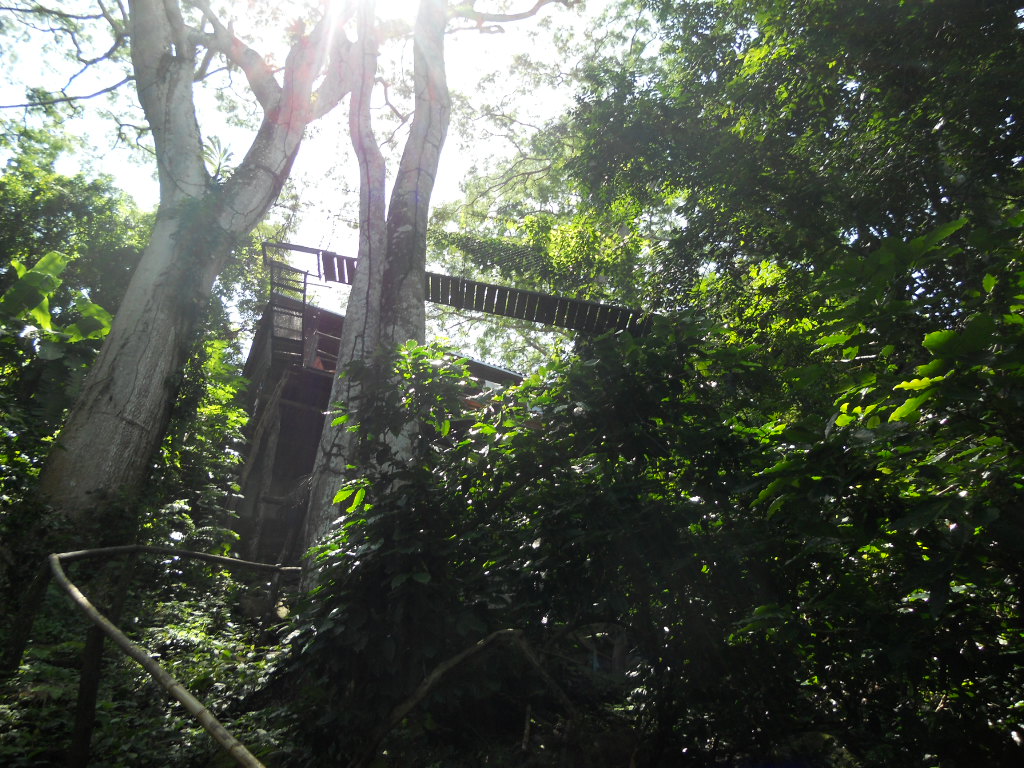
Freddys tree house hostel. It is simply called Tree House Hostel. Upstairs there is a kitchen, all the wather is still carried up by handforce.

Not surprizingly, to me anyway, studies and research in USA and Japan have showed that living in trees and near trees makes people happier. People preforme better on tests and form happier relationships when they live in an area with a lot of trees. According to Illinois University leafy streets also encourage a lower crime rate and a more "civilised" atmosphere, even in poor areas, researchers found this to be true. They believe that living close to parks and other green spaces is "essential to our physical, psychological and social well-being. Nature calms people and it also helps them psychologically rejuvenate. They are better able to handle challenges. Level of health could be predicted by the amount of green space within a mile of radius. In Chicago they found that trees can cut the level of crime by 7 %, and that children with ADHD were calmer and more focused after walking among trees, compared to children that are exercised indoors. In addition researchers in Japan also found that old people live longer if they have access to green area near their homes.


At the end of this blog there are some videos of amazing homes. Already people live in floating homes and floating cities. Who knows what the future have in store when it comes to ways of living. We only hope that a new way of living will be genteler to the nature and ourselves. That we will in the end live in harmony with our planet Earth, not fighting her. And that new ways of living will bring more happiness and love into a community.There is also even possibility of living inside live material.
House boat community; http://dornob.com/picture-this-seattle-houseboat-floating-home-photos/
links;
http://www.costaricatreehouse.net/
I love this green home, a "hobbit house"; http://dornob.com/straw-sticks-secrets-a-hand-built-earthen-hobbit-home/
http://www.tripadvisor.com/LocationPhotos-g580113-d1957230-w2-Treehouse_Poste_Rojo-Granada.html
Music that I heard in Posto Rojo.
http://nowthatsnifty.blogspot.com/2009/07/amazing-and-awesome-tree-houses.html
http://www.treehouses.com/
Who would not want to live in a tree house after seeing theese to WebSites?
There is something about a tree house that appeals to a lot of people's childhood fantasies of independence and freedom. I never had a tree house when I grew up, and when I came to Freddys tree house in Posto Rojo, just 20 min., out in the forest, from Granada (we saw a howler monkey right after we got there, feeding in the trees right next to the main house), I became quite facinated by the idea of LIVING in one. Freddy have 2 books on tree houses lying in the main structure for people to have a look if they like, and I was intrigued by how many designes there are. The books contain a detailed recepie of how to construct a tree house either in one or in 2 trees, and also what kind of trees that are most fit for tree houses. Of cource it is essential to pick the right tree, unless you want to live in danger of falling down.There are also surprisingly many tree houses in the world, and many of them serve as luxury hotels. Even though there are plenty of examples of people living most of their lives in tree houses, unfortunatley, todays obsession about safety, and laws and rules, have made it difficult for people to make tree houses their permanent home. A lot of the tree houses I saw and read about in the book where fully equipped with bathrooms and showers and a pumping system to get the wather up, and they all have a facinating architecture that inspire my sense of adventure and imagination. Many people have buildt their own tree house cabin or summerhouse, but there are many tree house architects. In some countries there are people living in tree houses either as a luxury, to save the environment or as a tradition. People that live in trees as a lifestyle are tree dwellers, you can find tree dwellers in Indonesia at the Brazza River Basin, and the Korowai tribe in Papua New Guinea that lives 50 m. (more or less) up with only a ladder and /or a notched pole to access the house. and I visisted in Brasil people with their homes on stilts and near trees with wooden bridges between the different stuctures. When the Europeans first came to this continent they found that many islanders were tree dwellers with a simple platform structures in the tops of the trees.
Freddys tree house hostel. It is simply called Tree House Hostel. Upstairs there is a kitchen, all the wather is still carried up by handforce.
Not surprizingly, to me anyway, studies and research in USA and Japan have showed that living in trees and near trees makes people happier. People preforme better on tests and form happier relationships when they live in an area with a lot of trees. According to Illinois University leafy streets also encourage a lower crime rate and a more "civilised" atmosphere, even in poor areas, researchers found this to be true. They believe that living close to parks and other green spaces is "essential to our physical, psychological and social well-being. Nature calms people and it also helps them psychologically rejuvenate. They are better able to handle challenges. Level of health could be predicted by the amount of green space within a mile of radius. In Chicago they found that trees can cut the level of crime by 7 %, and that children with ADHD were calmer and more focused after walking among trees, compared to children that are exercised indoors. In addition researchers in Japan also found that old people live longer if they have access to green area near their homes.
At the end of this blog there are some videos of amazing homes. Already people live in floating homes and floating cities. Who knows what the future have in store when it comes to ways of living. We only hope that a new way of living will be genteler to the nature and ourselves. That we will in the end live in harmony with our planet Earth, not fighting her. And that new ways of living will bring more happiness and love into a community.There is also even possibility of living inside live material.
House boat community; http://dornob.com/picture-this-seattle-houseboat-floating-home-photos/
links;
http://www.costaricatreehouse.net/
I love this green home, a "hobbit house"; http://dornob.com/straw-sticks-secrets-a-hand-built-earthen-hobbit-home/
Etiquetas:
adventure,
architect,
earth,
floating homes,
future,
green home,
imagination,
nature,
tree dwellers,
tree house,
way of living
Ubicación:
Granada, Nicaragua
Suscribirse a:
Entradas (Atom)